
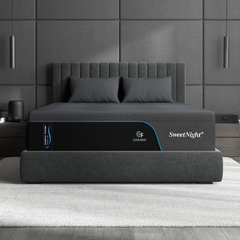


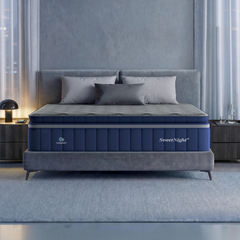

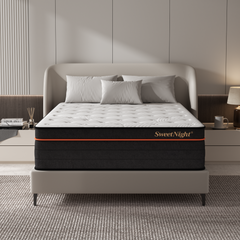
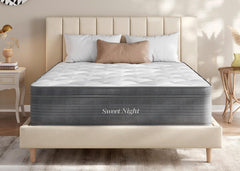
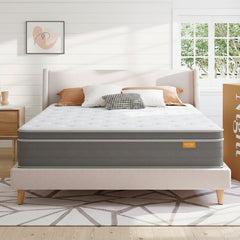
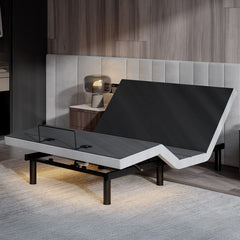
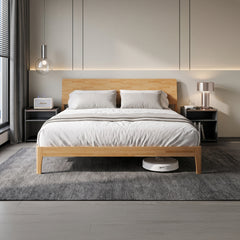



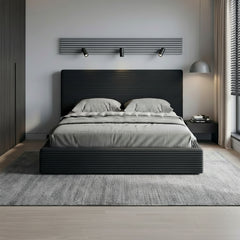

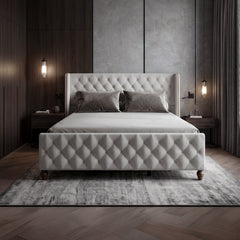




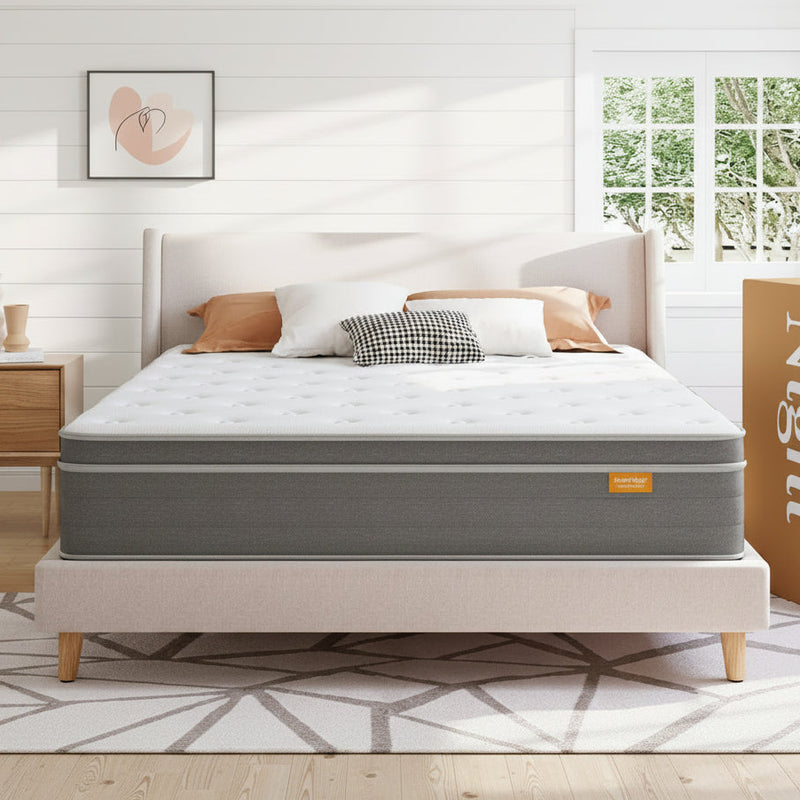
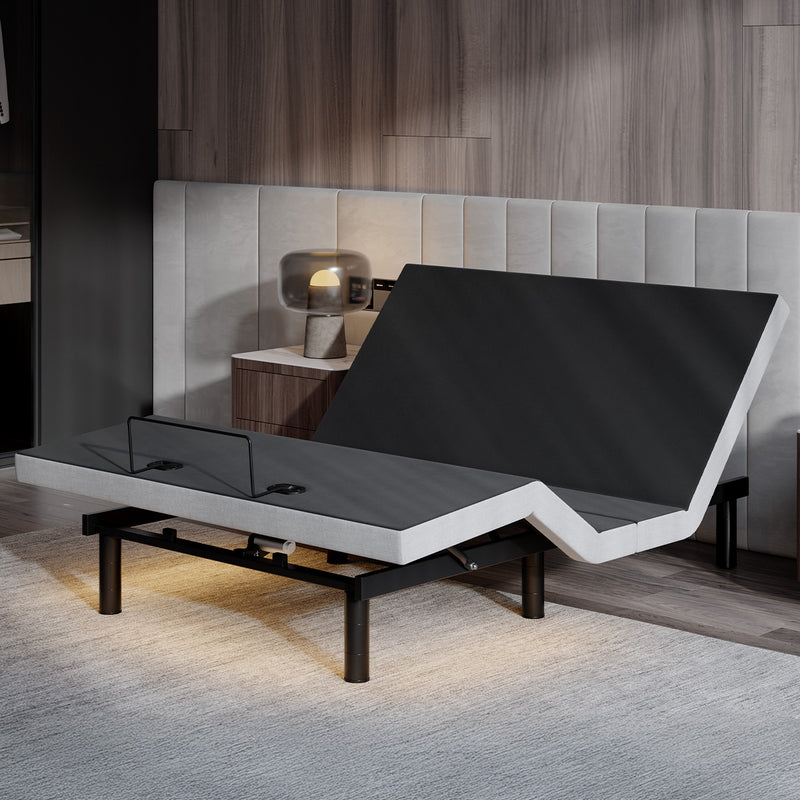
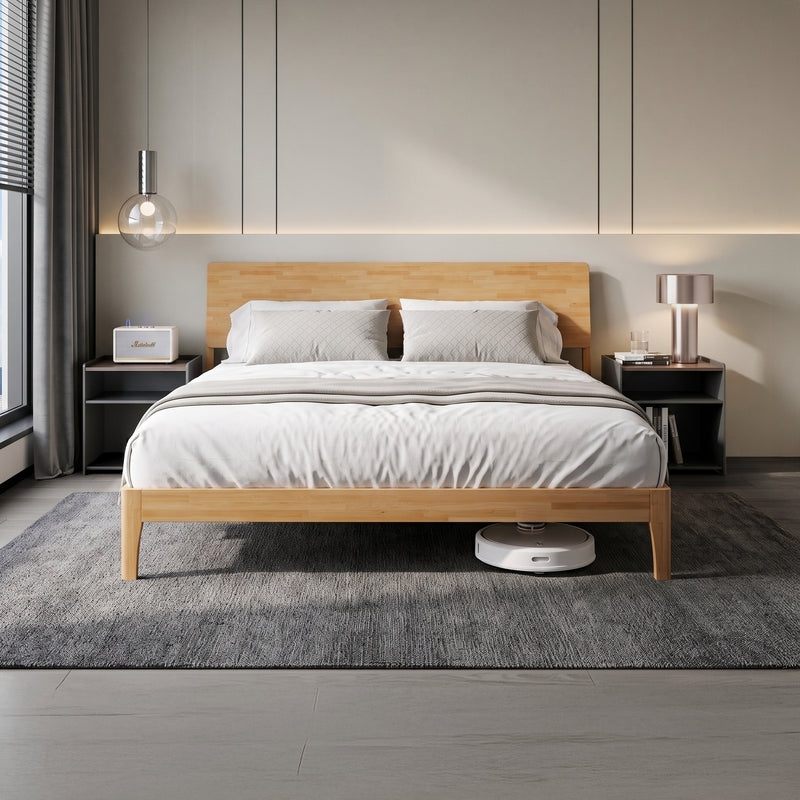

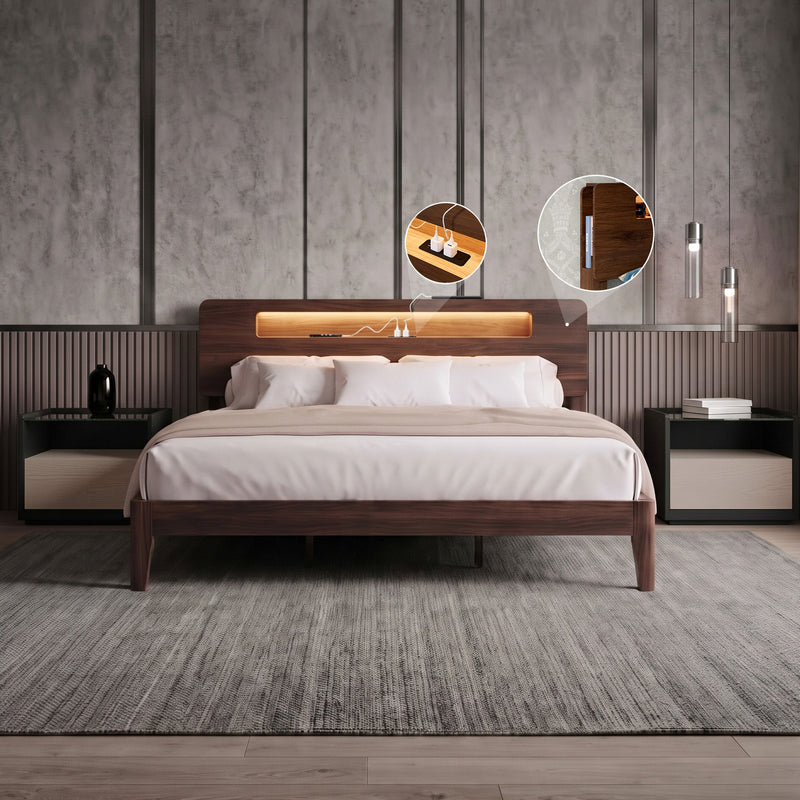

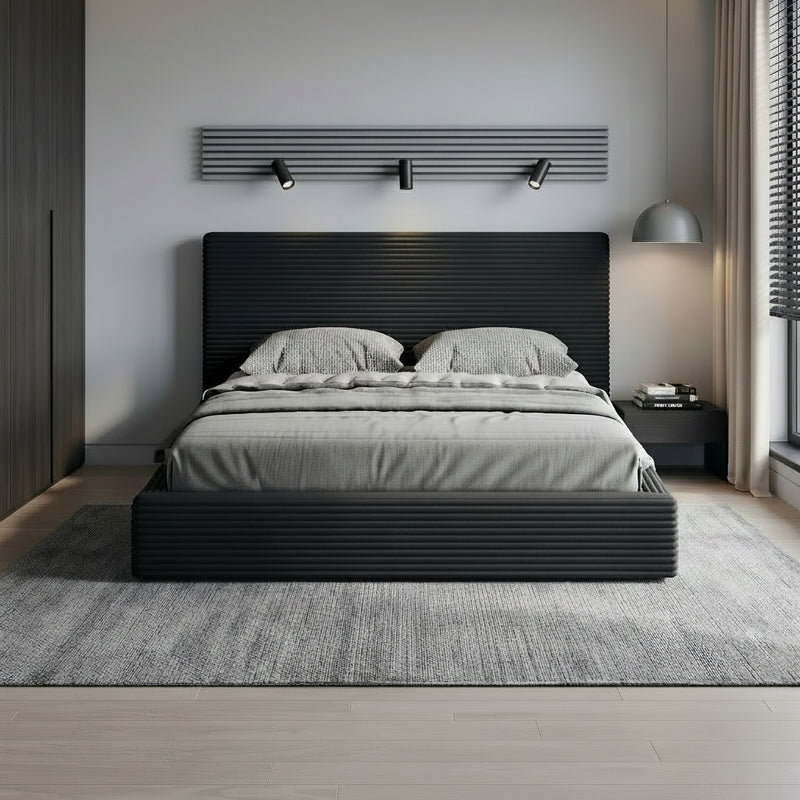
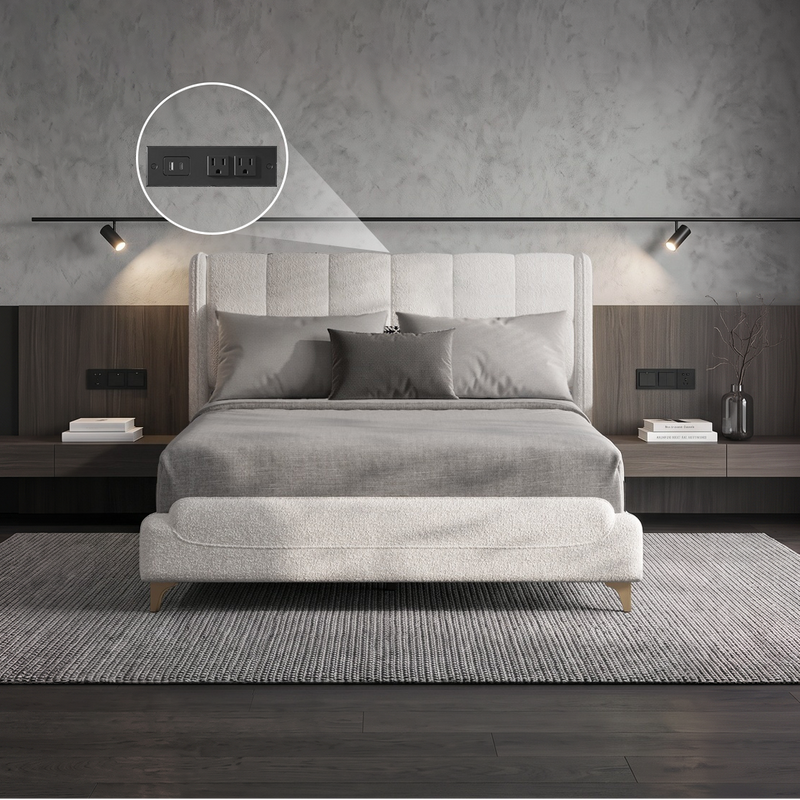
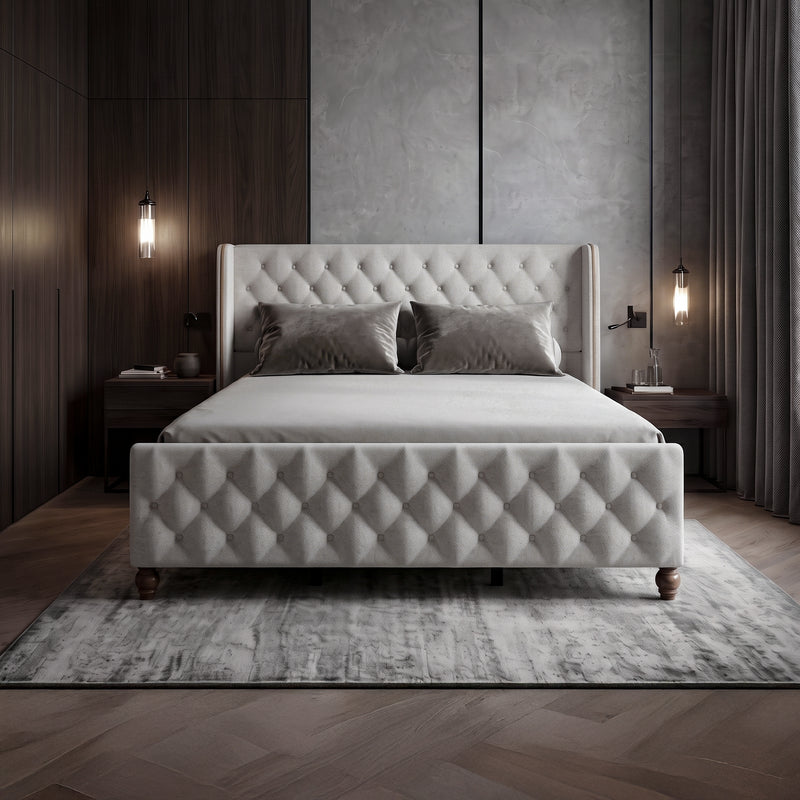
Yes, you can put an adjustable base in a bed frame, provided the frame's inside opening is a little larger than the base, the frame can carry the base plus the mattress and everyone on it, and nothing on the frame blocks the deck as it moves. If the opening is too small, you set the base on top of the frame's slats or platform instead, or you skip the frame and stand the base on its own legs. Box springs, bunkie boards, futon bases and sofa beds are the setups to avoid.
Four Ways to Set Up an Adjustable Base, With or Without a Bed Frame
Every adjustable base ends up in one of four arrangements, and each one changes what you need to measure.
1. Standalone on its own legs
No frame at all; the upholstered deck is what you see. It's the simplest setup. You give up the look of wood or upholstered rails and gain nothing to measure, rub against or squeak.
2. Inside an open cavity frame, legs on the floor
The base stands on its legs inside the rails, slats removed. The frame becomes a decorative surround and the weight goes through the base's legs to the floor. It's the neatest way to keep a frame you love, and the one with the least margin for error, because the base must clear the rails on all four sides.
3. Legless, on top of the frame's platform or slats
The legs come off and the base sits on the frame's platform or slats. Now the frame carries everything. Tempur-Pedic's help center says many power bases can sit directly inside a compatible platform bed or slatted frame with the legs removed, as long as the frame is built to support the base, the mattress and the sleepers together.
4. Zero-clearance, directly on the floor
Legs off, base on the floor. The lowest and most planted arrangement.
The SweetNight SenseSync™ Adjustable Bed Base supports all four: it can stand on its legs, which stack in 3-inch segments up to 12 inches, sit inside a compatible frame, rest on a platform, or go directly on the floor. (Disclosure: SweetNight makes the SenseSync base.) Its published dimensions are used in the examples below; the method works for any base.
What Bed Frames Are Compatible With an Adjustable Base?
Tempur-Pedic's support team puts it well: its bases work with solid frames or frames with removable slats, fit inside most modern bed frames, but may not fit antique or other non-standard frames. Its advice is to measure the inside of the frame and compare it with the base.
A frame is a good candidate when it has:
- An inside opening a bit larger than the base on every side.
- Either removable slats and center supports, or a solid, flat platform strong enough to carry the full load.
- Straight rails and a footboard that doesn't curve or lean into the bed.
- No under-bed drawers or storage boxes filling the cavity. Nectar, for example, tells buyers its adjustable frame won't fit inside a bed frame with drawers.
Then the load. A base's weight capacity counts the mattress and the people, and a frame under it also carries the base. A SenseSync Queen weighs 135 pounds and is rated for 750 pounds of mattress and sleepers, so at full rating a frame under it is holding about 885 pounds. A Full is 119 plus 750, or roughly 870 pounds. A Twin XL is 93.5 plus 400, or about 494 pounds. For comparison, Tempur's owner's manual for its Ergo base asks for frames certified to hold at least 950 pounds. Many decorative frames publish no load rating at all. If yours doesn't, choose a setup where the base's legs stand on the floor.
If you're buying a frame and a base at the same time, including from SweetNight's bed frame collection, don't assume a match from the size name. Get the frame's inside measurements from the listing or from customer support and run them through the recipe below before you order.
Open Cavity Bed Frames for Adjustable Beds
"Open cavity" means a frame whose middle is empty once the slats come out: rails, a headboard, maybe a footboard, and floor underneath. It's the arrangement Tempur describes when it says the slats may need to be removed for a base with its legs attached to fit and work properly.
Three things decide whether an open cavity frame works:
- The slats really come out. Some slat rolls are stapled or screwed down.
- The center rail and its support feet come out too, or sit clear of the base. Queen and King frames usually have a center beam with legs to the floor, sitting right where the base's own legs want to go. Nectar's FAQ says the same of its base: it fits inside a frame once the slats and center rail are out.
- The rail height suits the deck height (see the side-rail section).
If the slats are fixed, the frame isn't an open cavity frame, and you're in setup 3: base on top, legs off.
How to Measure a Bed Frame for an Adjustable Base
SweetNight's rule for SenseSync in an enclosed frame is that the frame's inside dimensions must be 0.4 to 0.8 inches (10 to 20 mm) larger than the base on every side. Never force a base into a tighter frame. Here's the ten-minute check.
- Pull the mattress and any slats so you can see the bare rails.
- Measure the inside width between the side rails at three points: near the headboard, at the middle and near the foot. Keep the smallest number.
- Measure the inside length from the headboard to the inside of the footboard or foot rail, on both sides.
- Look for anything that pokes into the opening: corner blocks, bolt heads, rail brackets, a center beam. Measure from those, not from the rail face.
- Subtract the base's width and length. Divide each difference by two. That's your clearance per side.
- Measure from the floor to the top edge of the side rails.
Here's the math with SenseSync's published base dimensions. "Per side" means half the total difference, so 0.4 to 0.8 inch per side works out to 0.8 to 1.6 inches in total.
| SenseSync size | Base (L × W) | Frame opening needed (L × W) | Compared with the nominal mattress |
|---|---|---|---|
| Twin XL | 79.7" × 37.6" | 80.5–81.3" × 38.4–39.2" | 0.5–1.3" longer, 0.4–1.2" wider than 80" × 38" |
| Full | 74.6" × 53.7" | 75.4–76.2" × 54.5–55.3" | 0.4–1.2" longer, 0.5–1.3" wider than 75" × 54" |
| Queen | 79.7" × 59.8" | 80.5–81.3" × 60.6–61.4" | 0.5–1.3" longer, 0.6–1.4" wider than 80" × 60" |
The last column is the useful one when you're shopping. A frame whose opening is cut exactly to the mattress size is too tight. Take a Queen frame that measures precisely 60 by 80 inches inside. Width: 60 minus 59.8 leaves 0.2 inch in total, or 0.1 inch per side, a quarter of the minimum. Length: 80 minus 79.7 leaves 0.15 inch per end. The same goes for a Full frame at exactly 54 by 75 and a Twin XL frame at exactly 38 by 80.
A passing Queen example: smallest inside width 61.0 inches, smallest inside length 80.9 inches. That's 1.2 inches of spare width (0.6 per side) and 1.2 inches of spare length (0.6 per end), both inside the 0.4 to 0.8 range.
The range has a ceiling too. With much more than 0.8 inch per side, the base can drift and leave a visible gap along the rails, so check with the base maker's support first.
If the opening is smaller than the base, leave the frame's slats or platform in place and set the base on top. The adjustable bed sizes and dimensions guide covers room clearance if you're still choosing a size.
Slatted Bed Frames for Adjustable Beds: The Slat Rule
When the base sits legless on slats, the slats become its foundation. For SenseSync, slats need to be at least 3 inches wide and no more than 4 inches apart, with center support on Queen and King frames.
A quick way to check without measuring every gap: with 3-inch slats and 4-inch gaps, each slat-plus-gap takes 7 inches. On an 80-inch Queen or Twin XL frame, that means you should count roughly 11 or more slats. Fewer than that and some gaps are wider than 4 inches. Wider slats can get away with fewer.
If your slats fail the rule, add or respace slats to close the gaps, or switch to a legs-on-the-floor setup. Laying plywood or a bunkie board over sparse slats is the tempting shortcut, and SenseSync isn't designed to sit on either.
Also check the center support. Queen and King slats span a long way between the side rails, which is why the rule calls for center support on Queen and King frames. Missing or loose center legs let slats sag and the base rock. Our guide on why adjustable beds wobble and squeak goes through the fixes.
Zero Clearance Adjustable Base: When Going Legless Makes Sense
A zero-clearance base is one designed to work with no legs at all: directly on the floor, or on a platform. Not every base is, so check the manual. SenseSync is built to run either way.
Go legless when you want the steadiest bed possible (no legs, nothing to rock on), when the base sits on a solid platform bed, or when you simply like a low bed. Keep the legs when you want the under-bed light to do its job, need to clean or store things underneath, or find a low bed hard to stand up from. Adding 3-inch leg segments fixes that last one.
One conflict worth flagging: Good Housekeeping's buying guide describes zero-clearance bases going directly on a bed frame or box spring. SenseSync is not designed for box springs, and Sleep Foundation's box spring guide states flatly that adjustable beds are incompatible with box springs. Follow your base's own manual, not a general review.
Side Rails, Footboards and Deck Height
Good Housekeeping's split king buying guide warns that frames without removable slats or with curved footboards or side rails can obstruct movement, and that you should check whether the base's height works with your frame.
- Rails much taller than the deck. If the side rails stand well above the top of the base's deck, the mattress sits down in a trough. Every time the head rises, the mattress sides drag along the rails and the cover wears. As a rule of thumb, aim for the deck top at or near the rail top.
- Rails much lower than the deck. Not a mechanical problem, but the base's sides show.
- A curved or inward-leaning footboard. The foot section and the mattress retainer bar need clear space at the end of the bed. On SenseSync that's a clip-on steel bar that stops the mattress sliding when the head rises, and an inward-curving footboard can crowd it.
With legs, you adjust deck height in 3-inch steps on SenseSync. SweetNight doesn't publish an overall deck height, so measure it after setup: fit the legs you plan to use, measure floor to deck top, and compare it with the rail height. If you land between steps, pick the step that brings the deck closest to the rail top without the mattress rubbing.
One more rule: don't fasten the base to the frame. Manufacturers such as Tempur warn that attaching an adjustable base to a bed frame's side rails can affect how the base performs and could void the warranty. If you were planning to use the frame to hold a headboard, see our guide to choosing a headboard for an adjustable bed, because SenseSync has no headboard brackets.
What Doesn't Work Under an Adjustable Base
For SenseSync, these supports are out:
- Box springs. A box spring is a foundation for a flat mattress, and Sleep Foundation's guidance is that adjustable beds and box springs don't mix.
- Plywood sheets and bunkie boards. The usual shortcut for bad slats, and one SenseSync isn't designed for.
- Futon bases. They're built to fold themselves, usually with open, widely spaced slats.
- Sofa beds. A folding mechanism under a folding mechanism, with a thin pull-out frame that was never meant to carry a motorized base.
Add to that list any frame you'd have to force the base into, frames with drawers filling the cavity, and antique or custom frames with odd inside dimensions. These don't rule out the frame, only the frame as a support.
The mattress matters as much as the frame. SenseSync is paired only with all-foam memory foam mattresses that are 12 or 14 inches thick. The reasons are in our guide to whether you need a special mattress for an adjustable bed.
Bed Frame for Adjustable Base: Decision Table
Match your situation to a setup, then check the one thing most likely to go wrong.
| Your situation | Best setup | Check first |
|---|---|---|
| No frame, or starting fresh | Standalone on the base's legs | Leg height for easy getting in and out |
| Frame with removable slats and center rail, opening 0.4–0.8" larger per side | Inside the frame, base on its legs | Smallest inside measurement; deck height vs rail top |
| Frame opening smaller than the base | Base on top of the slats or platform, legs off | Slats at least 3" wide, no more than 4" apart, center support |
| Solid platform bed | Base on the platform, legs off | Platform flat and stable; frame can carry base plus full load |
| Wants lowest, steadiest bed | Zero-clearance on the floor | Bed height still easy to stand up from |
| Frame with drawers, curved footboard or fixed center beam | Base on its own legs, frame elsewhere | Whether the frame can go |
| Box spring, bunkie board, futon or sofa bed | Not a support for the base | Replace with a compatible setup above |
Once you know the setup, the adjustable bed setup guide walks through delivery, unfolding the base and the first week. If you're still comparing bases, the SenseSync adjustable bed base page lists each size's dimensions, and our full SenseSync spec breakdown explains what the design choices are for.
FAQ
Can you put an adjustable base in a regular bed frame?
Usually, yes. The frame's inside opening has to be slightly larger than the base; SweetNight asks for 0.4 to 0.8 inch of clearance on every side for SenseSync. You'll normally remove the slats and center rail so the base stands on its own legs inside the rails. If the opening is smaller than the base, set the base on top of the slats or platform instead, legs off.
Do you need to remove slats for an adjustable base?
Only if the base is going inside the frame on its own legs. Then the slats and usually the center rail must come out so the base can sit on the floor between the rails. If the base sits on top of the frame with its legs removed, the slats stay in and carry the load, so they need to be at least 3 inches wide and no more than 4 inches apart, with center support.
What is a zero clearance adjustable base?
It's a base designed to work with no legs at all, sitting directly on the floor or on a solid, flat platform. Not every base allows it, so check the manual. Going legless is the most stable setup and gives the lowest bed. The trade-offs are no storage underneath, less use from an under-bed light, and a lower surface that some people find harder to stand up from.
Can you put an adjustable base on a box spring?
Not a SenseSync base, which isn't designed for box springs, and generally it's a poor idea. Sleep Foundation says adjustable beds are incompatible with box springs. Some reviews describe zero-clearance bases sitting on box springs, so if you own another brand, follow its manual. Otherwise use a platform, supportive slats, the floor or the base's own legs.
How much bigger should a bed frame be than an adjustable base?
For SenseSync, 0.4 to 0.8 inch larger on every side, which is 0.8 to 1.6 inches in total across the width and the length. For a Queen base of 79.7 by 59.8 inches, that means an inside opening of about 80.5 to 81.3 inches long and 60.6 to 61.4 inches wide. A frame cut exactly to a 60-by-80-inch Queen mattress is too tight.