
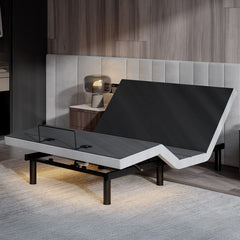



The zero gravity position is a reclined posture: head and upper back raised a little, knees bent, legs lifted to roughly heart level or slightly above, so your trunk, hips and knees all sit at open angles. The name comes from NASA's "neutral body posture," the shape a relaxed body drifts into in weightlessness. On an adjustable bed it is a comfortable way to rest, read or take weight off tired legs. It is not weightlessness, and the claims that it transforms your sleep run well ahead of the evidence.
Where the Zero Gravity Position Comes From: NASA's Neutral Body Posture
The source is less romantic than the marketing. It is a figure in the NASA Human Integration Design Handbook, a reference engineers use to design spacecraft workstations, handholds and foot restraints. Section 4.3 notes that in 0g "the fully erect standing posture of 1g is not comfortable," and that a relaxed body "immediately assumes a characteristic neutral body posture." The handbook credits that description to observational work from the 1970s (Thornton et al., 1977, and Webb Associates, 1978).
Figure 4.3-2 in the 2014 revision gives the average joint angles for a person held in place only by foot restraints:
| Measurement (NASA Fig. 4.3-2) | Mean angle | Person-to-person spread | What it means in plain terms |
|---|---|---|---|
| Trunk to thigh (hip) | 128° | ± 7° | Hips bent, roughly halfway between standing and sitting |
| Knee | 133° | ± 8° | Knees softly bent, well short of a chair's 90° |
| Foot to lower leg | 111° | ± 6° | Toes point slightly away; why NASA wants sloped foot restraints |
| Line of sight | 15° below horizontal | ± 2° | Head tips forward a little (10° is the figure given for 1g) |
Two lines in the handbook matter for anyone shopping for a bed. First: "The illustration represents a mean, and individual variations should be expected and accommodated." There is no single correct zero gravity angle, even in orbit. Second: "Maintaining a 1g posture in 0g will produce stress on the body as muscles are called on to supply stabilizing forces that gravity normally supplies." That is the real idea bed makers borrowed. The neutral posture is the shape your muscles pick when nothing forces them to hold a different one.
What the handbook does not say is just as important. It makes no claim about sleep, back pain, circulation or health of any kind. It is an ergonomics reference for people floating in a cabin. You will sometimes read that a specific space mission produced these numbers. The handbook itself only cites the 1977 and 1978 studies, so we will leave it there too.
What Is a Zero Gravity Bed, Then?
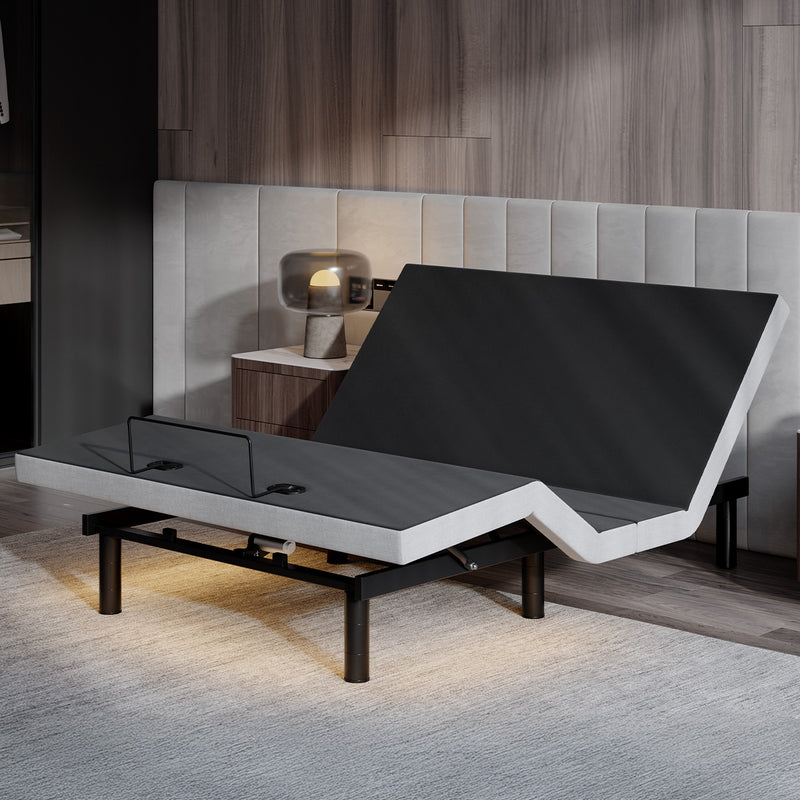
A zero gravity bed is an adjustable base with a preset that approximates that NASA shape while you lie on your back: head section up a little, foot section up enough that your knees bend and your lower legs come up to around the height of your heart. Think of it as "inspired by" the neutral body posture, never a replica of it. In orbit nothing presses on you. In your bedroom your whole weight still goes somewhere, mostly into your buttocks, the back of your thighs and your upper back, with the lower back unloaded because your knees are bent.
Brands define the preset differently, and some definitions drift a long way from NASA. Sleep Foundation's roundup of adjustable beds describes zero gravity as a position "in which the legs are elevated above the head," and quotes one product that sets the head at 120 degrees and the legs at 45. In NASA's figure the legs are not above the head at all. When you read "zero gravity" on a spec sheet, treat it as a brand's name for its own recline, and look at the actual angles if they are published.
If you like geometry, here is a rough way to translate. Lying on a base, your hip angle is about 180° minus how far your torso is tilted up, minus how far your thighs are tilted up. NASA's 128° hip angle means those two lifts add up to about 52°, for example a torso raised around 20 to 25° with thighs raised around 27 to 32°. Treat that as a sketch, not a setting. The numbers on a remote describe the deck, not your joints, and mattress thickness plus where your knees land relative to the hinge will shift the real angles by several degrees.
Benefits of a Zero Gravity Bed: What the Evidence Supports
We checked each common claim against two questions: is there a credible source for the mechanism, and has anyone tested it on a bed?
| Claimed benefit | What the sources actually say | Our verdict |
|---|---|---|
| Less swelling in feet and ankles | Cleveland Clinic and Mayo Clinic advise raising swollen legs above heart level. The mechanism is sound; no study tests zero gravity presets specifically. | Reasonable, if your feet actually end up above your heart |
| Lower back relief | Sleep Foundation and Cleveland Clinic recommend a pillow under the knees or a slightly raised torso for back sleepers. No trial of zero gravity beds. | Plausible for some back sleepers |
| "Better circulation" | Leg elevation helps return fluid from the legs. A small 1994 study of 15 venous insufficiency patients measured skin blood flow, not general circulation. | Overstated as a general health claim |
| Less snoring | Small studies of 10 to 20° trunk lifts show mixed results. Zero gravity head angles vary and are often low. | Use a dedicated head incline instead |
| Less acid reflux | Guidance centers on raising the whole torso and sleeping on the left side. | Not the right position for reflux |
| Deeper or better sleep | No clinical trial found. | Unproven |
How thin is the research? A PubMed search for zero gravity beds, chairs or recliners turns up mostly spaceflight bed-rest work. The closest consumer-furniture hit is a 2020 engineering study that used a zero-gravity chair as a stand-in for a tilt table while measuring heart rate variability. That is a diagnostic-equipment paper. It says nothing about sleep or pain.
The benefit with the best support: leg elevation
The zero gravity preset earns its keep when your legs feel heavy or puffy after a long day on your feet or a long flight. Cleveland Clinic's advice for chronic venous insufficiency is to lift the legs above the level of the heart; a provider may suggest doing it for 30 minutes or longer at least three times a day. The catch is the phrase "above the level of the heart." A preset that bends your knees but leaves your feet level with your chest isn't doing much draining. If swelling is the reason you are buying, check where your ankles end up, and read our guide to sleeping with your legs elevated for heights and timing.
The same Cleveland Clinic page lists "sleeping in a chair or recliner" as a risk factor for venous insufficiency. That refers to sitting with the legs hanging down. It is one reason a bed that raises the legs is a better place to doze than a recliner.
The back pain case: a mechanical knee pillow
For lower back pain, Sleep Foundation's guidance puts side sleeping with bent knees first, then back sleeping with a pillow under the knees or with the torso slightly raised. Zero gravity is essentially that second option built into the furniture: the knee bend lets the pelvis relax and eases the pull on the lower back. That is a real, modest comfort mechanism. It is not a treatment, and it suits some back problems better than others; our adjustable bed for back pain guide sorts pain patterns into the ones that like bending and the ones that don't.
Is the Zero Gravity Sleep Position Good for Sleeping All Night?
For a committed back sleeper who finds it comfortable, there is no reason not to. No source we reviewed shows harm from sleeping in a mild recline with the knees bent, and plenty of people sleep better simply because they are comfortable.
Most people, though, don't hold one position for eight hours. You roll, and the V shape of a full zero gravity preset makes rolling harder. Side sleepers get tipped back to the middle, and stomach sleeping is close to impossible. The pattern that works for many owners is to use zero gravity for the wind-down (reading, a podcast, the first drift toward sleep) and then drop the foot, or go flat, when they wake at 2 a.m.
Hip stiffness is the other trade-off. After hours with the hips bent, some people feel tight across the front of the hip when they first stand up. If you wake stiff, flatten the angles by a few degrees rather than giving up on the position.
How to Set Zero Gravity on an Adjustable Bed
A one-touch preset is a starting point. Getting it right takes about five minutes and two or three evenings of small changes.
- Start flat and lie where the bed bends. Your hips should sit near the hinge of the head section. Too far down the bed and the head section lifts your shoulders instead of your torso.
- Press the zero gravity preset. Then check three things: your knees bend comfortably, your feet are at or above chest height if swelling is the goal, and you don't feel pressure pooling at your tailbone.
- Lower your pillow. Once the head section rises, a thick pillow pushes your chin toward your chest. NASA's figure has the head tipped only slightly forward. A thinner pillow usually gets closer.
- Adjust head and foot separately. For tired, swollen legs, SweetNight's product team suggests a flat head with the foot at 20 to 35° as a starting point. For reading, raise the head more.
- Save it. Once you find your version, store it in a memory slot so you aren't rebuilding it every night.
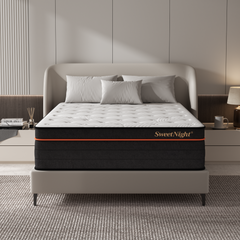
On the SweetNight SenseSync™ Adjustable Bed Base (disclosure: SweetNight makes it), the Z.G button raises the legs above heart level with the head slightly raised, and two motors move the head and foot independently, so step 4 is a matter of tapping the up and down buttons. Press and hold M1 or M2 to save the result, and press once to recall it. If you want to see the remote layout and the six comfort positions SweetNight recommends, the SenseSync adjustable bed base page lists them.
Try pillows first if you are unsure. A firm pillow under the knees and a folded blanket under the calves gives a back sleeper a crude zero gravity for a week. If you love it and keep rebuilding the pile, a base is worth a look. If you forget about it after three nights, keep your money.
Zero Gravity Bed Complaints (and What Actually Fixes Them)
Most complaints about zero gravity have little to do with the idea and a lot to do with setup, mattress choice or sharing a bed.
"I keep sliding down"
Any raised head section pulls you toward the foot of the bed. Research on raised hospital beds found that sliding 10 cm (about 4 inches) toward the foot cost 9.1° of real torso angle at a 30° setting, so the body ends up flatter than the bed says. Those were 10 healthy volunteers in hospital beds, so treat it as an analogy. Zero gravity actually helps here: the raised knee section acts as a brake. If you still slide, you are probably lying too low on the bed, or the head is set much higher than the foot.
"The mattress moves"
That is the mattress sliding on the deck, not you. A retainer bar at the foot fixes it; SenseSync has a clip-on steel one for this reason.
"The mattress fights the bend"
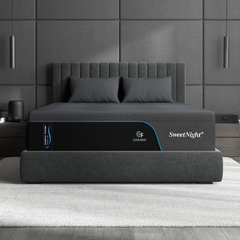
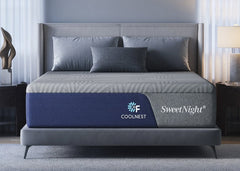
Every zero gravity cycle folds the mattress at two hinge points. All-foam mattresses bend evenly; coil units resist the fold and can pull away from the deck. SweetNight pairs the SenseSync base only with all-foam memory foam mattresses 12 or 14 inches thick, never a hybrid or a 16-inch model, because a thicker stack is stiffer across the fold. The CoolNest memory foam mattress in 12 or 14 inches is one option that meets that rule for Full and Queen.
"My partner hates it"
On a single Queen base, one person's zero gravity is the other person's zero gravity. If one of you wants legs up and the other wants flat, the fix is two bases, which is what a split king adjustable bed gives you: two Twin XL halves, each with its own remote, or paired to move together when you want them to.
"My hips ache when I get up"
Don't sit bolt upright from zero gravity. SweetNight's suggested routine is to lower the foot flat first, raise the head slowly from about 30° to 50°, then swing your legs out. It spares the lower back the sudden jackknife.
Who Should Skip Zero Gravity (or Use a Different Preset)
Side and stomach sleepers get the least from it. If you have never slept on your back, a bed preset won't change that. A gentle side-sleeper setting, with the foot at about 5 to 12° and the head at 5 to 8° per SweetNight's product team, is a better use of the motors.
People buying mainly for reflux or snoring need a different shape. Reflux guidance is about a steady torso incline and lying on your left side, which our guide to adjustable bed settings for acid reflux covers. For snoring, a small anti-snoring bed study tested trunk lifts of 10 to 20°, and the higher angle stopped more snoring episodes; zero gravity's head angle is usually lower.
Some people should skip the self-experiment and see a doctor first. New, one-sided or painful leg swelling, back pain with numbness or weakness, and snoring with gasping or pauses in breathing all need a medical look, not a better angle. And if bending at the waist makes your back pain worse, a flatter setup will likely suit you better than a deep V.
Zero gravity is the most pleasant preset on most adjustable beds, with a sensible mechanism behind it for tired legs and some sore backs. Buy a base for reading, resting your legs and changing positions easily, not for astronaut-grade sleep. For the wider picture of what posture does to the lower back, see why sleep position causes lower back pain.
FAQ
What is the zero gravity position on an adjustable bed?
It is a reclined preset that raises your head and upper back a little and lifts your knees and legs to about heart level or higher, so your hips and knees stay bent at open angles. Bed makers model it on NASA's neutral body posture, the shape a relaxed body takes in weightlessness. Exact angles vary by brand, and on Earth it spreads your weight differently rather than removing it.
Is it safe to sleep in the zero gravity position all night?
For most healthy back sleepers, yes, if it stays comfortable. Nothing in the research shows harm, and nothing shows it improves sleep either. The practical limits are comfort: side sleepers get pushed onto their backs, and some people wake with stiff hips. Many people use zero gravity to fall asleep, then lower the bed to a gentler angle or flat when they wake during the night.
Is zero gravity good for lower back pain?
It can help some back sleepers. Sleep Foundation and Cleveland Clinic both suggest a pillow under the knees or a slightly raised torso for back pain, and zero gravity does both mechanically. No clinical trial has tested zero-gravity beds for back pain, though. If your pain eases when you lean forward, a bent posture may feel good; if bending makes it worse, try a flatter setting and see a clinician.
Can you sleep on your side in zero gravity?
Not comfortably in the full preset. The V shape tips most people back toward the middle, and the bend lands in the wrong place for a side-lying hip. Side sleepers usually do better with a much gentler version: SweetNight's product team suggests about 5 to 12 degrees at the foot and 5 to 8 degrees at the head as a starting point, then small adjustments from there.
Does the zero gravity position help with acid reflux?
It is not the best reflux position. Reflux advice centers on raising the whole torso, not the knees, and on sleeping on your left side. The head lift in most zero gravity presets is modest. If heartburn wakes you at night, set a steady head incline instead, eat earlier in the evening, and talk to a doctor if symptoms show up more than twice a week.