




























Most adjustable beds wobble or squeak for ordinary mechanical reasons: legs that are too tall or not fully seated, bolts that have worked loose, a floor that isn't level, or the base knocking against a bed frame or wall. A smaller share of the noise comes from the motors themselves, and some of that is normal. Most of it can be traced with a flashlight, a wrench and a second person on the remote.
Below: the causes in the order they're usually found, a fix for each, what makes a quiet adjustable bed, and what a 48 to 50 dB motor rating means in a real bedroom.
Why Do Adjustable Beds Wobble?
A regular bed frame is a static box. An adjustable base carries a moving deck and has to stay steady while the load shifts. When you raise the head, a large share of the weight on the bed moves toward one end. When someone rolls over at 30 degrees, they push sideways on a deck that's hinged, not flat. Anything with play in it will show that play.
These are the causes that come up most, roughly from most to least common:
- Legs. Adjustable bases usually stand on stackable leg segments. Each joint between segments is a small hinge point, and a taller stack is a longer lever. A leg that isn't threaded all the way home, or one that's a segment shorter than the others, turns the base into a four-legged chair on a bad floor.
- The floor. Old wood floors dip, tile has lippage, and thick carpet compresses more under one leg than another. Sleep Foundation's advice on squeaky beds starts with making sure the bed is even with the floor, and that applies doubly to a base that moves.
- Loose fasteners. Frame connections, leg plates and the retainer bar clip can all loosen over the first weeks as the base goes through its first few hundred movements.
- Frame contact. A base set inside a decorative bed frame can knock against the side rails or footboard when it moves or when you sit on the edge. This is the most common source of a hollow thump.
- Weight on a raised section. Sitting on the edge of a raised head section, or kneeling on it, loads one end in a way the base isn't built for. Tempur's help center puts it plainly: bases support their rated weight distributed evenly across the head and foot, and are not designed to lift that weight in the head or foot section alone.
Wobble is rarely just wobble for long. A joint that moves wears, and a joint that wears eventually makes noise.
Adjustable Bed Squeaking: Where the Noise Comes From
The fastest way to find a squeak is to note when it happens. A sound that only occurs while the motors run has a different source from one that happens when you roll over on a still bed. Use this table to narrow it down before you pick up a tool.
| When you hear it | What it sounds like | Most likely source | First thing to try |
|---|---|---|---|
| Rolling over, bed not moving | Squeak or creak that follows your body | Mattress coils, or a loose frame joint under you | Unplug, lie still, have someone press on each corner; check joints nearest the sound |
| Rolling over, bed not moving | Rhythmic tick or knock | Leg rocking on the floor, or base touching a side rail | Check each leg for contact; look for rub marks on the frame |
| Head or foot rising or lowering | Steady hum | Motor and actuator doing their job | Nothing, if it's even and doesn't change over time |
| Head or foot rising or lowering | Scrape, rub or fabric squeal | Deck panel rubbing the frame, retainer bar, bedding caught in a hinge | Run it with the mattress off and watch the hinge line |
| Head or foot rising or lowering | Grinding, clicking or labored strain | Overload, an obstruction, or a worn actuator | Stop, clear under the bed, reduce load; contact support if it persists |
| Getting in or out | Metallic pop from one corner | Leg segment not seated, uneven floor | Reseat the leg, level the floor contact |
Don't skip the mattress row. Sleep Foundation notes that all-foam mattresses won't squeak, while innerspring and hybrid mattresses are more prone to noise because of their metal springs. To rule it out, unplug the base, put the mattress on the floor for a night, and listen.
How to Fix a Wobbly Adjustable Bed, Step by Step
Do this with the bed flat and unplugged, and with two people. Adjustable bases are heavy (Sleep Foundation says most weigh 140 to 200 pounds), so take the mattress off first. Keep hands out of the hinge areas at all times.
- Clear the space under the bed. Storage boxes, a dropped shoe or a cord trapped under a leg will cause wobble on their own, and they can also block the deck as it lowers.
- Check every leg. Unscrew and rethread any segment that isn't fully seated. Count segments; every leg should have the same number. On a base with stackable threaded segments, a single cross-threaded joint can rock.
- Drop the height if you can. If you stacked legs higher than you need, take a segment out of each. A shorter lever wobbles less. The lowest setup is zero-clearance, with no legs at all, if the base allows it.
- Level the floor contact. On hard floors, add furniture pads or shims under the leg that doesn't touch. On carpet, a firm furniture cup under each leg keeps one side from sinking. Sleep Foundation also suggests pads under the legs to cut noise between frame and floor.
- Tighten what you can see. Frame joints, leg mounting plates and the retainer bar fittings. Snug, not forced; stripping a thread creates a new problem.
- Check the surroundings. Pull the base away from the wall, nightstands and any surrounding bed frame, run it through a full cycle with the mattress off, and watch for anything it touches.
- Put the mattress back and retest. Have one person roll across the bed while the other watches the legs and corners.
If the base sits inside a bed frame
This deserves its own check, because it's the setup that generates the most knocking. The base must never be bolted or wedged to the frame. Tempur's support team says it doesn't recommend attaching an adjustable base to a bed frame's side rails, since it can affect performance and could void the warranty. For the SenseSync base, SweetNight's rule is that an enclosed frame's inside dimensions need to be 0.4 to 0.8 inches larger than the base on every side. Less than that and the two will touch. Much more and the base can shift until it does. Felt pads on the inside of the rails help once the gap is right. Our guide on fitting an adjustable base in a bed frame covers measuring and slat rules in detail.
How to Fix a Squeaky Adjustable Bed
Once the wobble is gone, a lot of squeaks go with it, because a squeak is usually two parts moving against each other. What's left is typically metal-on-metal contact at a joint or fabric rubbing at a hinge.
Metal joints and bolts
Sleep Foundation's general advice for beds is to tighten every joint and consider plastic washers to avoid the metal-on-metal contact that often causes squeaking. Nylon washers under a bolt head at a frame joint are cheap and work well. Their article also suggests a lubricant such as WD-40 on the joints of metal frames.
That article is about beds in general, not motorized bases, so apply it with care. Put lubricant only on exposed bolts and pivot points where you can see metal touching metal, wipe off the excess, and keep it away from motors, actuators, the control box, wiring and the upholstered deck. Read the manual first; if it tells you not to lubricate a part, don't.
Fabric and deck rub
The deck on most bases is padded panels covered in fabric. At the hinge line, panel edges can rub each other or the steel as they fold. Run the base up and down with the mattress off and watch that line. A fitted sheet or mattress protector tucked too far down can also get pinched there and squeal. Pull bedding clear of the hinges and the sound often disappears.
The retainer bar
The bar at the foot that stops the mattress sliding can rattle if it isn't fully clipped in. Remove it, reseat it and check the fit.
Is Adjustable Bed Motor Noise Normal?
Some of it is. Every powered base uses motors, and they make sound while they run. Sleep Foundation's mattress-for-adjustable-bed guide says that in most cases, noise from an adjustable bed only occurs when the motors are raising or lowering part of the bed. Manufacturers also document some mechanical sounds as expected. Tempur's Ergo owner's manual, for example, notes that the wheels that keep its base at a set distance from the wall make a contact noise against the steel supports during normal operation, and calls that normal.
Healthy motor noise is a steady, even hum that sounds the same every time. These changes are worth taking seriously:
- A grinding or ratcheting sound, or a click at the same point on every lift.
- The motor sounding strained or slowing near the top of travel.
- The base stopping or reversing partway, which on many bases (SenseSync included) is obstacle protection telling you something is in the way.
Strain usually means too much load or an obstruction. Check that nothing is under the bed, that nobody is sitting on the raised section, and that the total weight is within the rating, which on most bases includes the mattress. Also check how you're using it. Tempur's Ergo manual says its lift motors aren't designed to run continuously for more than two minutes in an eighteen-minute period. Holding the buttons for long stretches while hunting for an angle isn't how motors like these are meant to be used. If the noise persists on a clear, lightly loaded base, stop and contact the maker's support rather than opening the actuator yourself.
What Makes a Quiet Adjustable Bed?
Some bases are simply built to wobble and squeak less. If you're still shopping, these design choices tell you more than the word "whisper" in a product name. Our adjustable bed buyer's guide covers the other specs.
| Design choice | Why it helps | What to check on a spec sheet |
|---|---|---|
| Wide bottom support area | Spreads load over more floor and resists rocking | Photos of the underside; leg count and position |
| Lower center of gravity | Less leverage for a roll-over or a jumping pet to act on | Frame height without legs; how low it can sit |
| Zero-clearance option | No legs means no leg wobble | Whether legs are removable and the base can sit on the floor or a platform |
| Short leg segments | You use only the height you need | Segment size and maximum height |
| Published dB figure | A number you can compare, not an adjective | Loaded and no-load noise levels |
| Steel frame with rigid joints | Fewer connections that can work loose | Frame material; how much is pre-assembled |
Many brands describe motors as quiet without giving a number. Nectar's site, for example, lists a "Whisper-Soft Motor" and "whisper-quiet massage" without a decibel figure. That doesn't mean those motors are loud; it means you can't compare them.
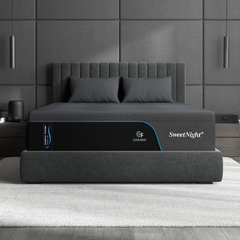
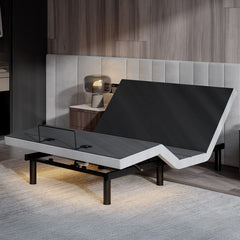
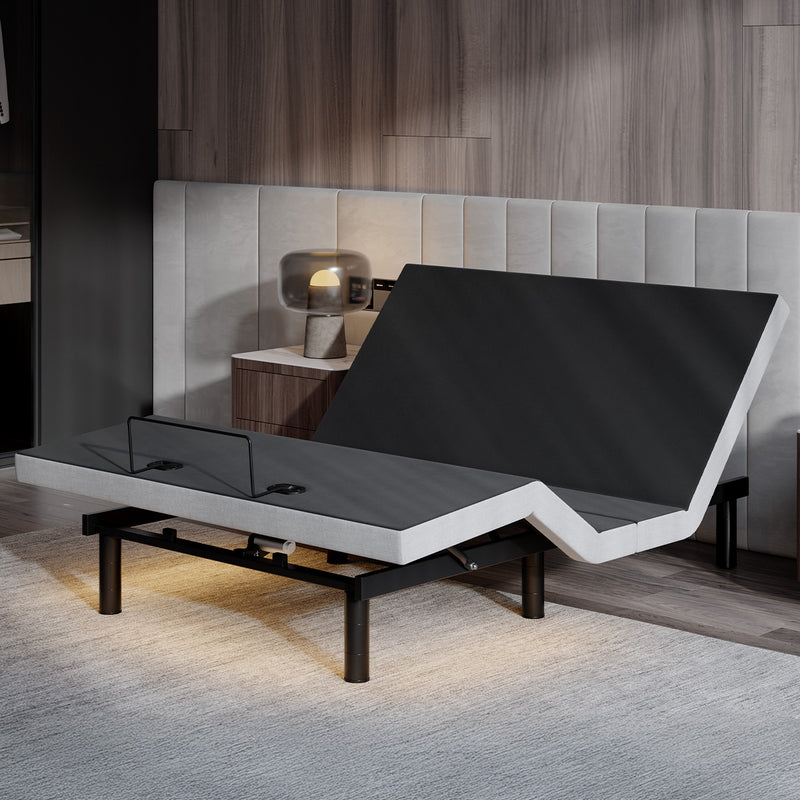
Wobble was one of the complaints SweetNight designed around when it built the SenseSync adjustable bed base. (Disclosure: SweetNight makes the SenseSync base.) Its zero-gap support structure uses a widened bottom support area and a lower center of gravity to cut wobble and shifting when the base moves, when a partner turns over, or when a pet jumps up. It can sit directly on the floor or a platform without legs, and its legs come in 3-inch segments up to 12 inches, so you only add the height you want. The motors are rated at 48 dB or less with no load and 50 dB or less under load. That's the maker's spec, not an independent lab result. The full SenseSync spec breakdown explains the rest of the frame.
What 48 to 50 dB Means in a Bedroom
Decibels are logarithmic, so the gap between numbers is bigger than it looks. The NIH's hearing institute lists normal conversation at 60 to 70 dBA. A Purdue University noise chart, a secondary source built on older reference tables, describes 50 dB as about one-fourth as loud as 70 dB, in the range of a quiet suburb or conversation at home, and 40 dB as roughly library-quiet.
So a motor rated at 48 to 50 dB is quieter than two people talking at the end of the bed, and louder than a silent room. You'll hear it. Whether it bothers a sleeping partner depends mostly on duration. A base moves for a few seconds, then stops, and then it's silent unless something is loose. That's why the squeaks and knocks in the earlier sections, which happen every time someone rolls over, tend to disturb sleep more than the motor ever does.
One caution when comparing specs: a decibel figure depends on how and where it was measured, and brands don't always say, so don't read much into a 2 dB difference between two brands.
When a Wobble or Noise Means Stop and Call Support
Most of what's above is maintenance. A few signs mean the fix is a warranty claim, not a wrench:
- A crack, bend or broken weld in the steel frame.
- A motor that runs but the section doesn't move, or moves in jerks.
- Burning smells, or a warm control box.
- One side sagging when flat, or a section that drifts down on its own.
- Noise that returns within days of tightening everything.
Before you call, note when the noise happens and what you've already checked. Motors and electronics are typically covered for a shorter period than the frame, so check which tier your base is in. Our article on how long adjustable beds last explains how those warranty tiers work, and if you're setting a base up for the first time, the adjustable bed setup guide covers the checks that prevent most of these problems in the first place.
FAQ
Is it normal for an adjustable bed to make noise?
Some noise is normal. The motors hum while the head or foot is moving, and Tempur's own owner's manual describes a contact noise from its wall-distance wheels as normal. What is not normal is noise when the bed is still and someone moves on it, grinding or clicking from a motor, or a sound that is getting louder week by week. Those point to a loose part, frame contact or a worn component.
Can I use WD-40 on a squeaky adjustable bed?
Sleep Foundation suggests a lubricant such as WD-40 on the metal joints of ordinary bed frames. On a motorized base, apply it only to exposed metal-on-metal pivots and bolts, wipe off the excess, and keep it away from the motors, the control box, wiring and the upholstered deck. Check your base's manual first, because some makers say which parts may be lubricated.
Why does my adjustable bed wobble when I roll over?
The usual causes are legs that are not fully seated or are stacked taller than you need, an uneven floor or soft carpet under one leg, loose frame bolts, and a base that knocks against the side rails of a surrounding bed frame. Lowering the legs, leveling the floor contact and tightening the joints fixes most cases. A zero-clearance setup removes leg wobble entirely.
How loud is 50 dB for an adjustable bed?
The NIH's hearing institute puts normal conversation at about 60 to 70 dBA. A university noise chart from Purdue describes 50 dB as roughly one-fourth as loud as 70 dB and places it near a quiet suburb or conversation at home. A base rated at 48 to 50 dB is quieter than people talking, and it only makes that sound for the few seconds it is moving.
Does the mattress affect adjustable bed squeaking?
Yes. Sleep Foundation notes that all-foam mattresses do not squeak, while innerspring and hybrid mattresses are more prone to noise because of their metal springs. If the creak moves with you when you shift your weight and stays when the base is flat and unplugged, the mattress is a likely source, not the base.