














The best sleeping position for acid reflux is on your left side with your whole upper body on an incline, so your head ends up about 6 to 8 inches higher than it would be lying flat. Raise the torso from the hips rather than propping up the head alone: a stack of pillows bends your neck and leaves your esophagus nearly level. An adjustable bed, a foam wedge or blocks under the bed legs can all create that slope. Stop eating two to three hours before bed, and see a doctor if heartburn keeps coming back despite these changes.
The details matter, because the evidence is thinner than most blog posts admit and the recommended heights come in inches while beds are sold in degrees.
Why Acid Reflux Gets Worse When You Lie Down
Upright, gravity keeps stomach contents below the valve at the bottom of the esophagus and drains back any acid that escapes. Lie flat and both advantages disappear. The Sleep Foundation's explainer on sleeping upright puts it simply: sitting upright makes it harder for stomach acid to flow up the esophagus than lying flat on your back.
Side matters too. The American College of Gastroenterology's 2022 GERD guideline notes that lying right-side down increases nocturnal reflux and reflux after meals compared with lying left-side down, probably because the right side puts the junction between the stomach and esophagus below the pool of stomach contents. The guideline's practical takeaway is that patients might be advised to avoid sleeping right side down.
Timing is the third factor: a full stomach at bedtime means more contents sitting near that valve just as gravity stops helping. Incline, side and meal timing each address a different part of the problem, which is why they work best together.
What Is the Best Sleeping Position for Acid Reflux?
Left side down
This is the best-supported position change for reflux. In a 100-patient sham-controlled trial published in 2022, people wore a small device that vibrated when they rolled onto their right side, nudging them to sleep on their left. Treatment success (at least a 50% reduction in nighttime reflux score) came in at 44% in the device group versus 24% with a sham device. A separate pH-impedance study of 57 patients found shorter acid exposure and faster acid clearance on the left side than on the back or the right side, and a 2023 meta-analysis reached the same conclusion, though it rested on only three studies.
Incline plus left side
The two changes appear to add up. A small 2015 trial by Person and colleagues in 20 healthy volunteers compared an inclined positioning device with the sleeper on the left side, the same device on the right side, a standard wedge and lying flat. Left side on the incline produced significantly less acid exposure than the others. Right side on the incline produced the most, despite the incline. Two caveats: the volunteers did not have GERD, and one author was affiliated with the company that made the device. Still, the pattern fits the rest of the literature: an incline does not rescue a right-side position.
Back and stomach
Back sleeping on an incline is a reasonable second choice if you cannot stay on your side. Stomach sleeping is the hard case; a Cleveland Clinic gastroenterologist says flatly that wedge pillows are not going to work for stomach sleepers.
How High to Elevate the Head of the Bed for Reflux
Every reputable source gives the answer in inches, and they do not quite agree:
- Mayo Clinic says to raise the head end of the bed 6 to 9 inches with blocks under the legs, or to use a wedge that elevates you from the waist up.
- NIDDK, part of the NIH, suggests a foam wedge or extra pillows under your head and upper back, raising your head 6 to 8 inches off the bed. Cleveland Clinic uses the same 6 to 8 inch range.
- The Sleep Foundation says to raise the top of the bed itself, rather than piling up pillows, by at least 6 inches, and names an adjustable bed frame as one easy way to do it.
Treat 6 to 8 inches as the target and the upper end of Mayo's range as the ceiling for most people. The trials behind these numbers used similar heights: 8-inch bed blocks in a 1988 crossover study and 20-cm (about 8-inch) blocks in a 2012 trial.
Converting inches to degrees
Bases and wedges are sold in degrees. On a hinged base the head section pivots near your hips, and your head rises by its distance from that pivot multiplied by the sine of the angle. Measure from where your body bends to where your head rests, then pick the closest column.
| Head-section angle | Head rise if head is 26" from hinge | 30" from hinge | 34" from hinge |
|---|---|---|---|
| 10° | 4.5" | 5.2" | 5.9" |
| 15° | 6.7" | 7.8" | 8.8" |
| 20° | 8.9" | 10.3" | 11.6" |
| 25° | 11.0" | 12.7" | 14.4" |
| 30° | 13.0" | 15.0" | 17.0" |
Read across the 15° row and you land inside the 6 to 8 inch range for most adults. The 6 to 8 inch target works out to roughly 10° to 18°, depending on body size. Anything past about 25° is sitting up more than sleeping, which brings its own problems (more on that in our guide to sleeping upright).
One detail most guides skip: 6 to 9 inches of blocks under the head legs of an 80-inch bed tilts the whole mattress, feet included, by only about 4° to 6°. A hinged base angles only the torso, so at 15° the slope from stomach to throat is steeper than blocks give. No trial has compared the two directly, so treat that as geometry rather than proof.
Does Sleeping on an Incline Help GERD? What the Evidence Says
It probably helps nighttime symptoms for many people, but the evidence is weaker than most product pages suggest.
| Source | What was studied | What it found | Limits |
|---|---|---|---|
| ACG clinical guideline, 2022 | Expert review of the literature | Suggests raising the head of the bed for nighttime GERD symptoms | Conditional recommendation, low level of evidence |
| Albarqouni et al., BMC Family Practice, 2021 | Systematic review: 5 trials, 228 patients (bed blocks, wedges or both) | 4 trials reporting symptoms found improvement with head-of-bed elevation | All 5 trials at high risk of performance bias; too weak for definitive recommendations |
| Khan et al., 2012 | 20 people with nighttime reflux, 20-cm blocks for 6 nights | Less acid exposure, faster acid clearance; sleep improved in 65% | Small, no separate control group |
| Hamilton et al., 1988 | 15 people, wedge vs 8-inch blocks vs flat | Wedge significantly cut acid exposure vs flat; blocks similar but not significant | Small, old; not everyone liked the wedge |
| Hirunrattanaporn et al., 2026 | 24 people already on a morning PPI: wedge vs extra evening PPI dose, 4 weeks | Wedge was not inferior for nighttime symptoms; better sleep quality | Very small, short; no clear difference in measured reflux |
The ACG wording is often inflated, so here it is exactly: "We suggest elevating head of bed for nighttime GERD symptoms," graded as a conditional recommendation with a low level of evidence. It covers nighttime symptoms only, and it is a suggestion rather than a strong recommendation.
The 2021 systematic review by Albarqouni and colleagues screened 1,206 records and found only five trials worth including. Its conclusion is the most honest summary available: the evidence cannot support definitive recommendations, but head-of-bed elevation could still be considered a cheap and safe option.
The newest data point matters most if you take medication. In the 2026 wedge-pillow trial, adding a wedge to a morning PPI controlled nighttime symptoms as well as a second evening dose, with better sleep. With 24 people over four weeks, that is something to discuss with your doctor, not a reason to change a prescription on your own.
A 2022 review of nighttime reflux treatments pulled these threads into a sequence: raise the head of the bed, leave more time between dinner and bed, promote left-side sleeping, and then add acid-suppressing medication.
Why Stacked Pillows Don't Work for Acid Reflux
Mayo Clinic says raising your head with additional pillows isn't effective, while NIDDK and Cleveland Clinic list extra pillows as an option. The difference is placement. NIDDK specifies pillows under your head and upper back so your body inclines. Cleveland Clinic's gastroenterologist makes the same distinction from the other side: regular pillows only elevate your head, which isn't enough, while a wedge raises the entire torso.
Three pillows under your head flex your neck forward and leave the part that matters, the stretch from stomach to lower esophagus, close to level. If you use pillows, build a ramp that starts at the lower back. Most people find that ramp collapses by morning, which is why wedges, blocks and adjustable bases exist.
If you are weighing a wedge against a base, our wedge pillow vs adjustable bed comparison covers cost, sliding and the geometry of each in more detail.
Adjustable Bed for Acid Reflux: How to Set It Up
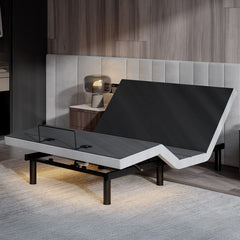
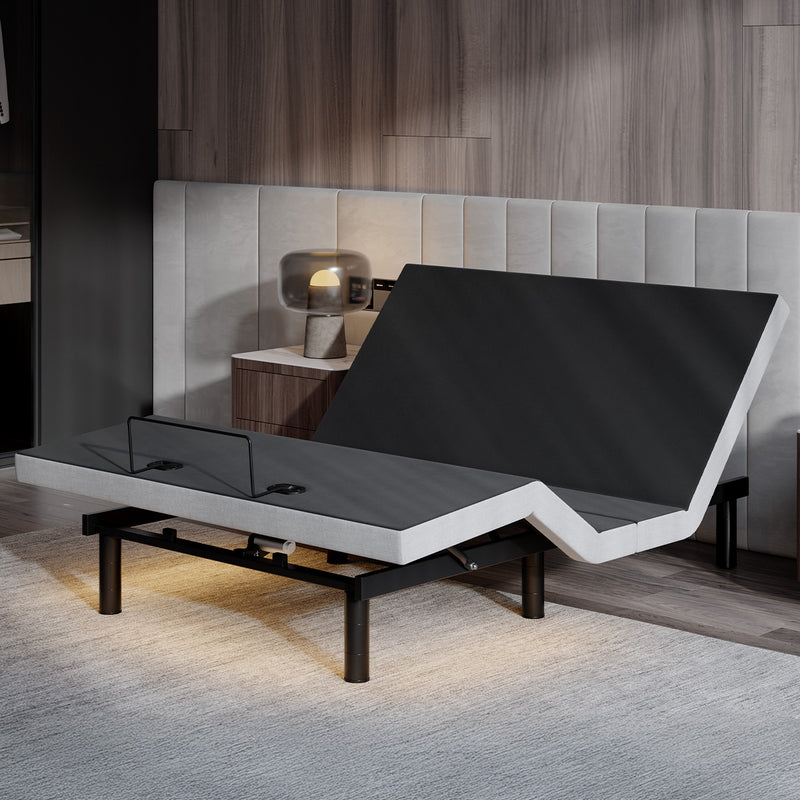
An adjustable base does the same job as blocks or a wedge, with two practical advantages: you can change the angle in small steps until you find the lowest one that works, and you can go flat without moving furniture. Here is a setup recipe.
1. Start at about 15° and adjust from there
On the SenseSync adjustable bed base, the Anti-Snore preset lifts the head about 15°, which lands in the 6 to 8 inch range for most adults according to the table above. (Disclosure: SweetNight makes the SenseSync base.) SweetNight's own setup guidance is that many people with reflux end up at 15° to 20° or a little higher. If you wake with symptoms after a week at 15°, raise it a few degrees. If your lower back or hips complain, come down a little.
2. Lie with your hips at the hinge
The torso should bend where the bed bends. If you lie too far toward the foot, the fold hits your lower back and you get a slumped curve instead of a straight ramp. Scoot up until the bend in the mattress sits at the crease of your hips.
3. Add a small knee lift to stop sliding
People slide toward the foot of a raised bed. The only data comes from hospital beds, in small studies funded by the bed maker Hill-Rom: sliding 10 cm (about 4 inches) erased roughly 9° of torso angle at a 30° setting. A slight foot-section lift gives your hips something to rest against. SweetNight's starting point for side sleepers is 5° to 12° at the foot with a modest head angle; for reflux, keep the head at your reflux setting and use the foot lift only as a brake.
4. Roll onto your left side
The incline and the side position work together. A body pillow behind you helps you stay on your left side.
5. Save it
Once you find the angle, save it to a memory preset if your base has one, so you land in the same position every night.
A note on mattresses
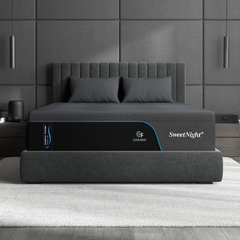
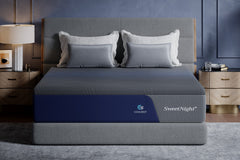
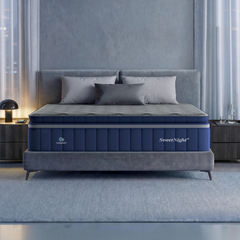
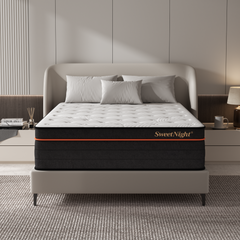
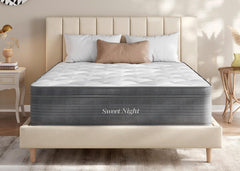
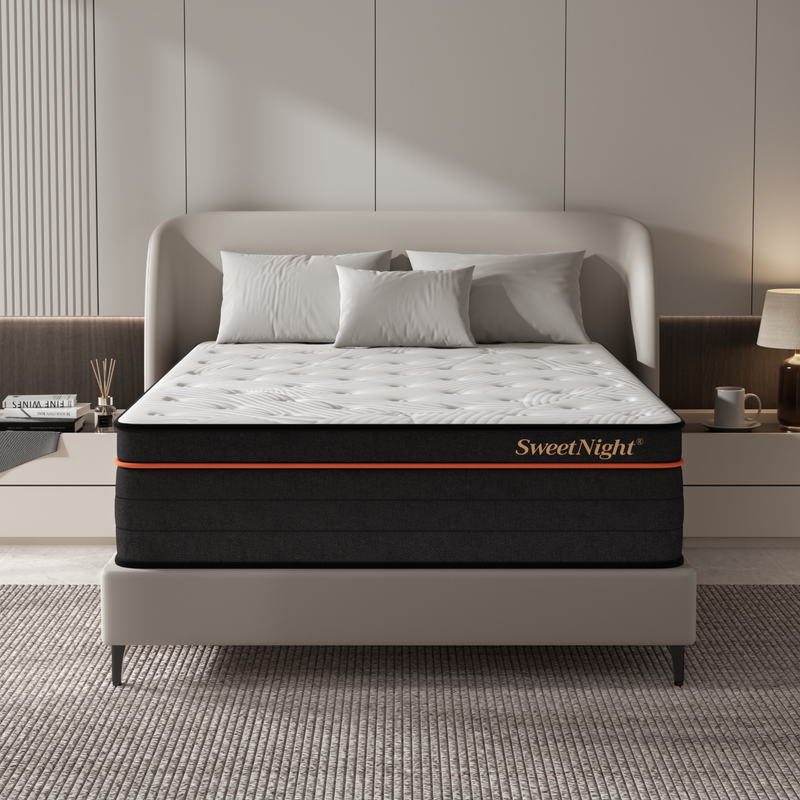
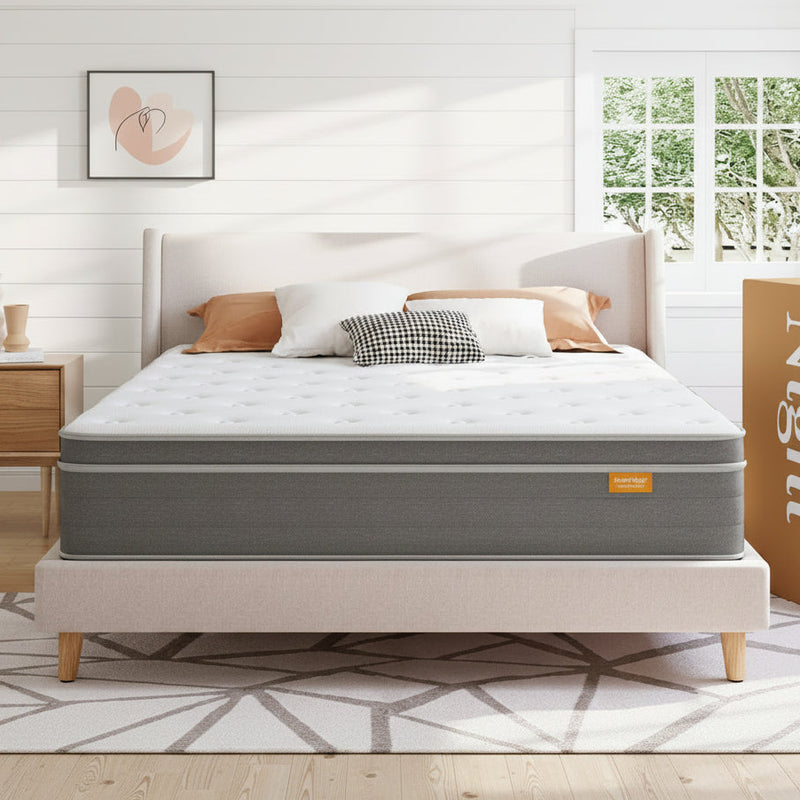
The mattress has to bend with the base every time you raise it. SweetNight specifies the SenseSync base for all-foam memory foam mattresses 12 or 14 inches thick only, because foam folds evenly at the hinge, while coil units resist the bend and thicker mattresses fold less predictably. A CoolNest memory foam mattress in 12 or 14 inches fits that rule. Our guide to whether you need a special mattress for an adjustable bed explains the mechanics.
How to Sleep With Acid Reflux: A Nightly Routine
- Finish dinner early. The ACG suggests avoiding meals within 2 to 3 hours of bedtime; Mayo Clinic says to wait at least three hours after eating before lying down. Late snacks count.
- Start on your left side. Mayo Clinic's advice is to begin the night that way. You will move, but the early hours after a meal are when it matters most.
- Keep the incline all night. If your hips feel stiff at 2 a.m., drop a few degrees instead of going flat.
- Track what happens. Two weeks of simple notes (angle, dinner time, side, symptoms) will tell you more than any article.
If you share a bed, the incline is the part most likely to cause friction. A partner who snores may actually welcome a raised head (see our article on the adjustable bed for snoring and sleep apnea), but one who wants to sleep flat will not. A Split King setup, two Twin XL bases side by side, lets each person choose their own angle.
When Acid Reflux Needs a Doctor, Not a New Bed
NIDDK estimates that about 20% of people in the United States have GERD. Common does not mean you should self-manage indefinitely. Talk to a doctor if you have heartburn most weeks, if symptoms persist despite the changes above, or if you rely on antacids to get through the night. In a US survey of 71,812 people, 54.1% of those taking a daily PPI still had GERD symptoms, which argues for a proper evaluation over more pills or more pillows.
Some symptoms call for prompt medical attention rather than a lifestyle experiment, such as trouble swallowing. Chest pain can come from the heart rather than the esophagus; if you are not sure which, treat it as an emergency.
An adjustable bed can make an evidence-based habit easier to keep. It does not treat GERD and does not replace a diagnosis.
Who Should Skip the Adjustable Bed
A base is overkill for some people with reflux.
- If your reflux shows up only after big or late meals, fix the meal timing first. It costs nothing.
- If you want to test whether an incline helps at all, a foam wedge or bed risers is the cheap trial. If it works and you can live with it, you may be done.
- If you sleep on your stomach and cannot change, no incline device will do much.
- If you have a hybrid or innerspring mattress you love, the SenseSync base is not the right match, since it is designed for all-foam mattresses only.
A base earns its cost when the incline clearly helps, a wedge keeps sliding out from under you, your partner wants to sleep flat, or you also use the bed for reading and watching TV.
FAQ
What is the best sleeping position for acid reflux?
For most people with nighttime reflux, the best position is lying on the left side with the whole upper body on a gentle incline, so the head ends up roughly 6 to 8 inches above flat. Lying on the right side is linked to more reflux, and lying flat on your back lets acid linger longer. Stomach sleeping works poorly with any incline.
How high should you elevate the head of your bed for acid reflux?
NIDDK and Cleveland Clinic suggest raising the head 6 to 8 inches; Mayo Clinic says to raise the head end of the bed 6 to 9 inches. On a hinged adjustable base, that works out to roughly 10 to 18 degrees at the head section, depending on how far your head sits from the hinge. Start low and raise it a little at a time.
Is an adjustable bed good for GERD?
An adjustable bed is one practical way to raise your torso at night, which the American College of Gastroenterology suggests for nighttime GERD symptoms as a conditional recommendation based on low-quality evidence. It does not treat GERD. It can make the incline easier to keep up every night, lets you fine-tune the angle, and lets a partner sleep flat on a split setup.
Why is my acid reflux worse at night?
When you lie flat, gravity no longer helps keep stomach contents down or clear acid that reaches the esophagus, so acid can sit there longer. Eating close to bedtime adds to the problem because the stomach is still full. Lying on the right side also puts the junction between stomach and esophagus in a position that favors reflux.
Can I just use extra pillows for acid reflux?
Stacking pillows under your head usually bends you at the neck and does little for the esophagus, and Mayo Clinic says extra pillows are not effective. If you use pillows, they need to support your head and upper back so your whole torso slopes. A foam wedge, bed risers or an adjustable base give a more stable slope.