
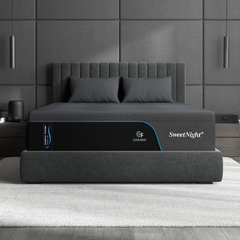

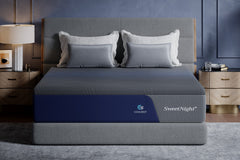
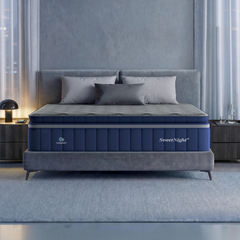

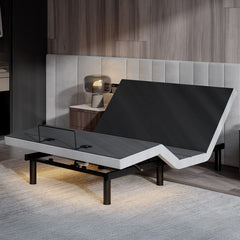
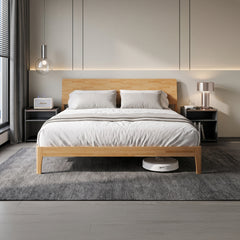




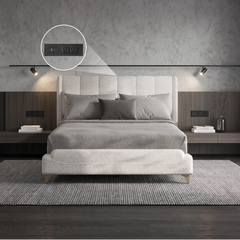





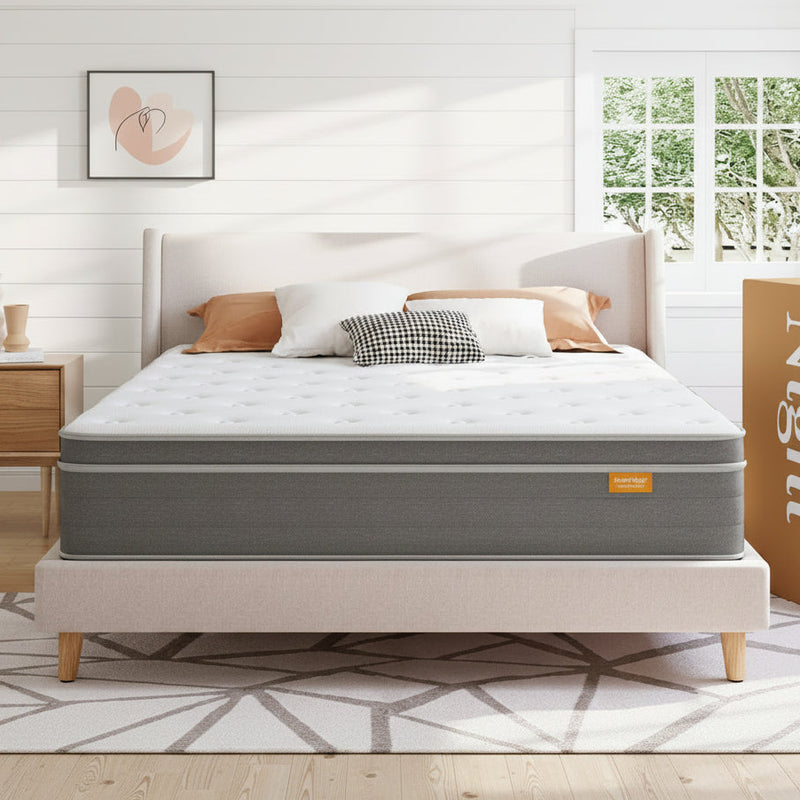
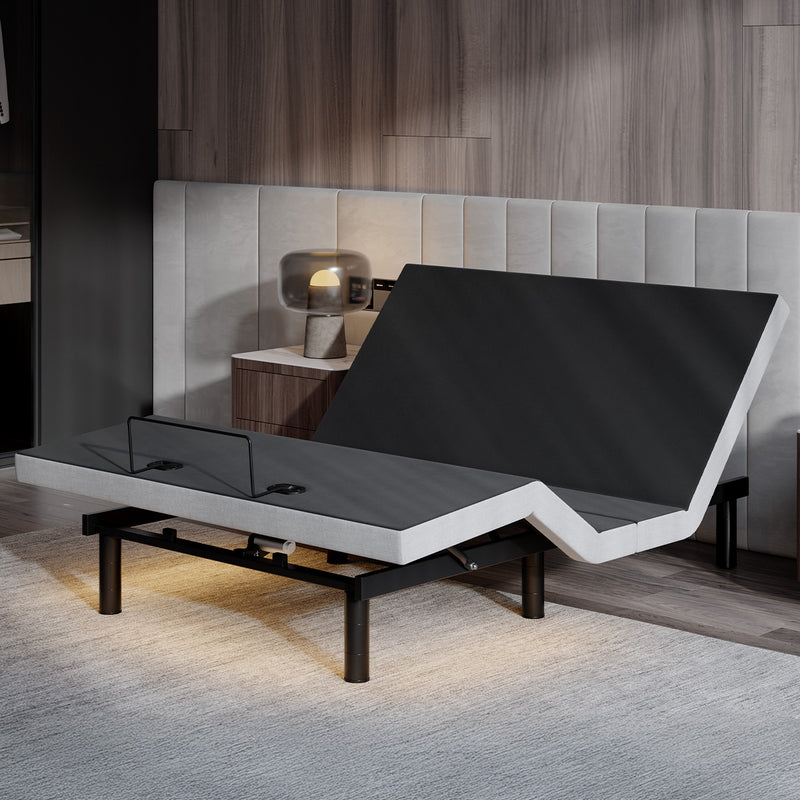
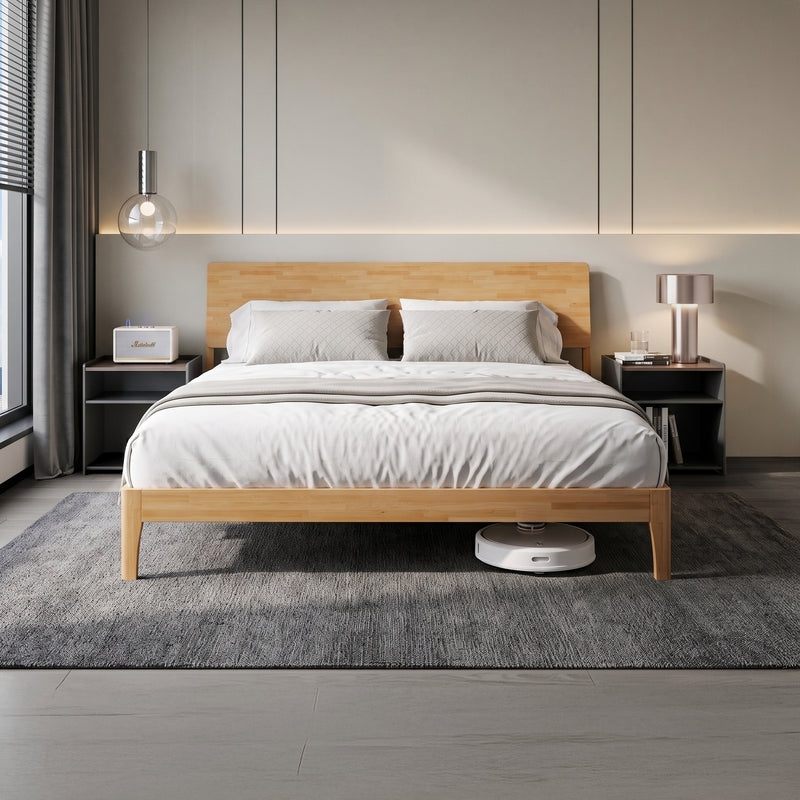

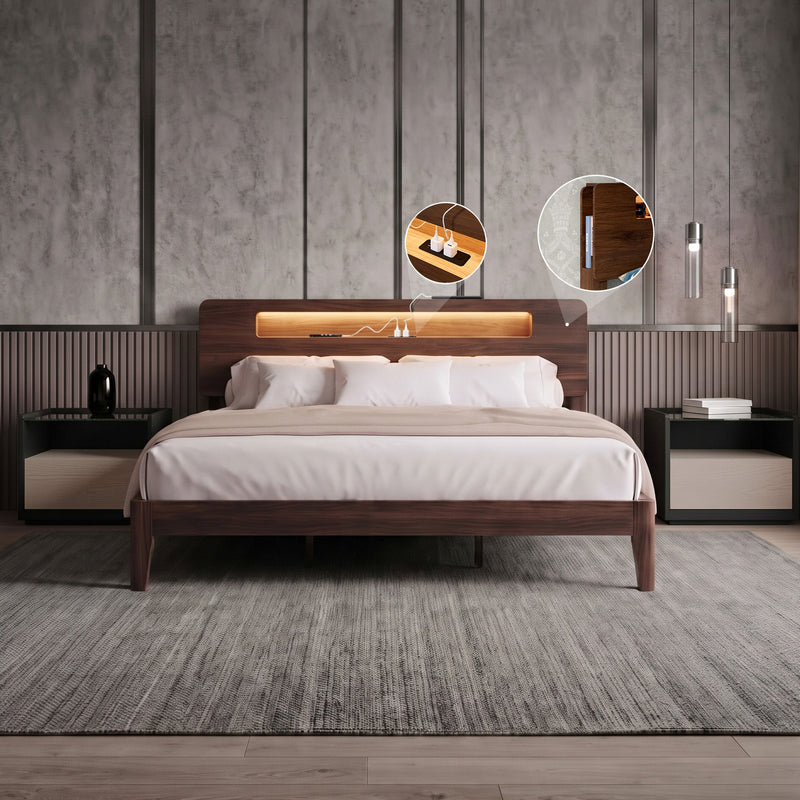

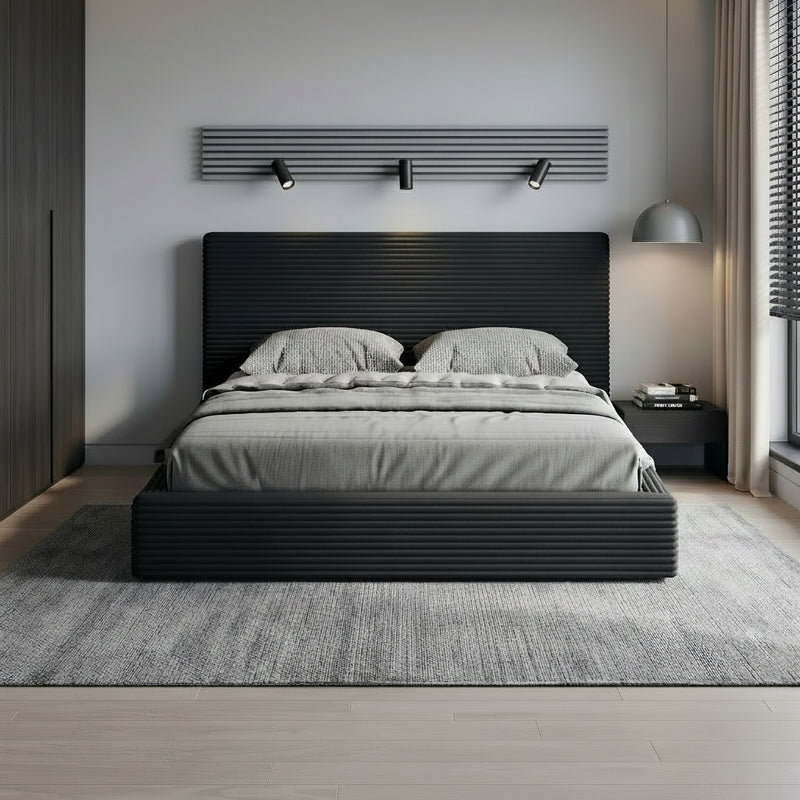
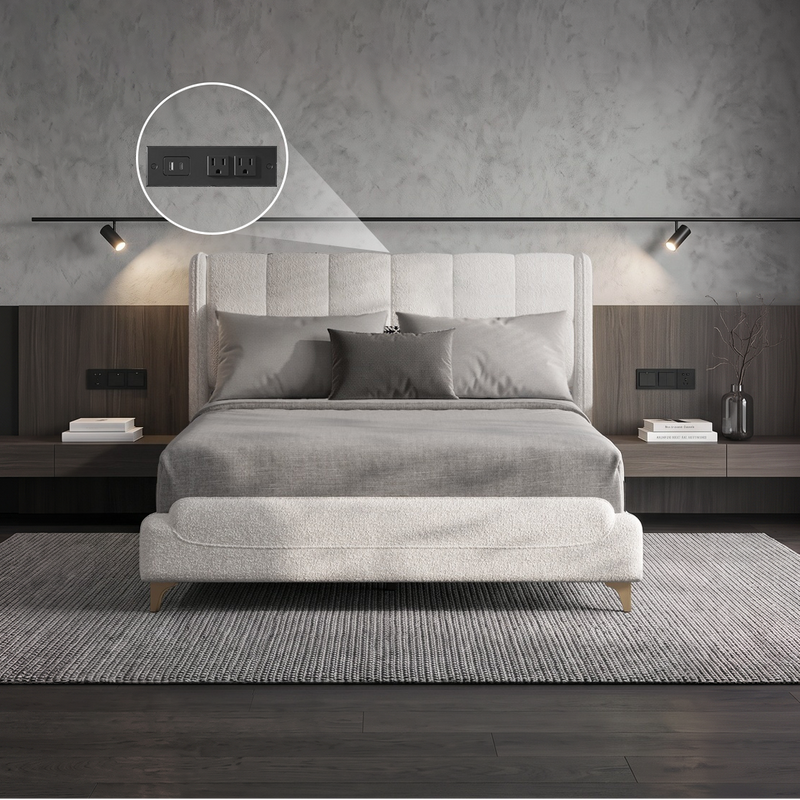
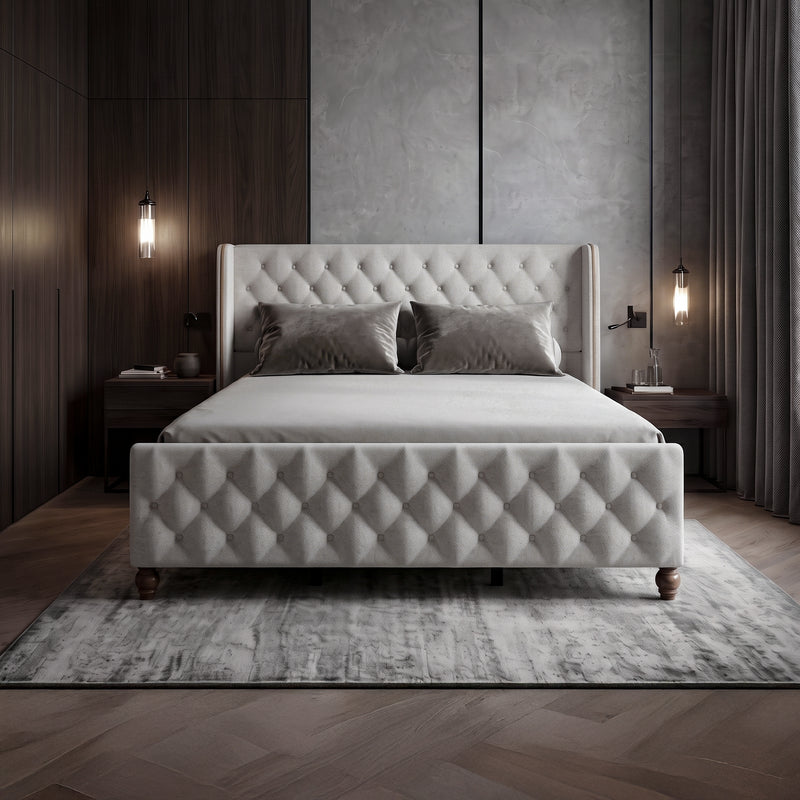
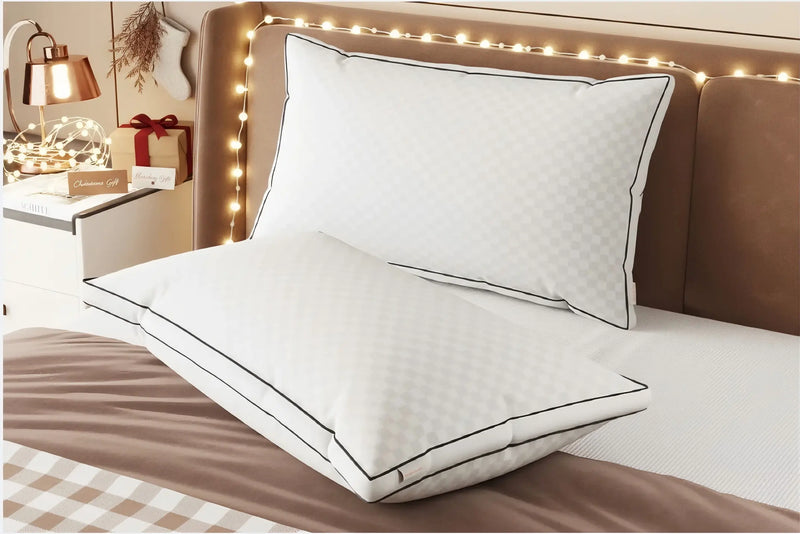
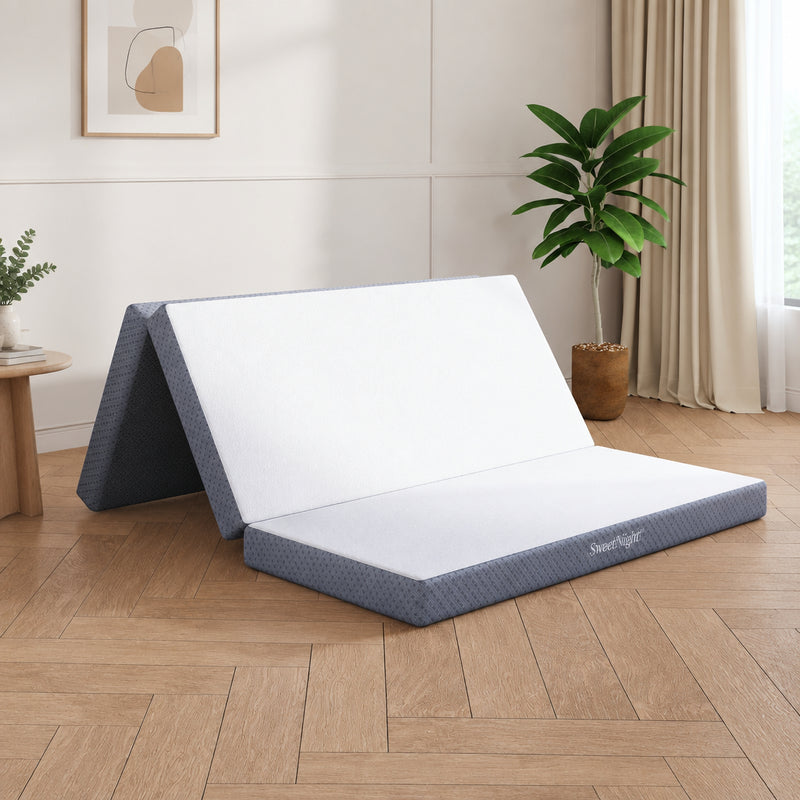
Yes, you can have a headboard with an adjustable bed, but on most setups it doesn't attach to the part that moves. You either surround the base with a bed frame that has its own headboard, mount a headboard on the wall, stand a freestanding headboard behind the bed, or, on bases sold with a bracket kit, bolt the headboard to the base's fixed frame. The SweetNight SenseSync™ Adjustable Bed Base has no headboard brackets and isn't a wall-hugger, so on SenseSync the first three routes are the ones that work. (Disclosure: SweetNight makes the SenseSync base.)
Picking the headboard is the easy part. The two things people don't plan for are the gap that opens behind the pillow when the head rises, and the nightstand that ends up behind your shoulder. Both are covered below, with the height math for a base whose legs change in 3-inch steps.
Can You Put a Headboard on an Adjustable Bed?
You can, with one mental adjustment. On a flat bed the headboard is a backrest: you sit up against it to read. On an adjustable bed the raised head section is the backrest, and the headboard becomes mostly a wall treatment. Once you accept that, the choices get simpler, because the headboard no longer has to take anyone's weight.
What it does have to handle is a bed that changes shape. The head end of the mattress rises and, on most bases, moves toward the foot as it goes up. The base may also sit higher or lower depending on its legs. A headboard that's fixed to the floor or wall has to look right with the bed flat and not get in the way when it's raised.
Some brands solve the attachment question with brackets. Tempur-Pedic's help center says you can use a headboard with its power bases but you need to buy its headboard bracket kits, and Serta's baselogic product pages list headboard brackets as an optional purchase. In both cases the brackets are sold separately. SenseSync has no bracket kit and no mounting points for one. We wouldn't improvise a bracket by drilling into the steel frame either; it's not something the base was designed or tested for. The headboard needs its own support.
What Is a Wall Hugger Adjustable Bed?
A wall hugger is a base whose mechanism slides the head section back toward the wall as it rises, so you stay in the same spot relative to the wall and your nightstand. Sleep Foundation describes a wall-hugging design as one that keeps a fixed distance between the bed and the wall, so the nightstand stays within reach in every position. Good Housekeeping describes it the same way, and notes of one base without it that raising the head may push you out of reach of your nightstand. Brands use different names; Sleep Foundation mentions "wall glide" for one of them.
These are reviewers' descriptions rather than a formal standard, so look for the feature by name in the spec sheet, not in a photo.
A regular base is the opposite. The head section pivots up from a hinge, and its top edge swings in toward the foot of the bed as it rises. Nectar's FAQ is refreshingly direct about its own base: it's not a wall hugger, and raising the head pulls the head portion away from the wall. Serta says its baselogic bases don't have the feature either. SenseSync is in the same group.
How much does it move? It depends on the length of the head section and the angle, so treat this as geometry, not a SenseSync measurement. For an imaginary 30-inch head section, the far edge pulls in by about 4 inches at 30°, about 9 inches at 45° and 15 inches at 60° (the section length times one minus the cosine of the angle). The top edge of the mattress travels further than the deck edge because it sits a mattress-thickness above the hinge. The takeaway: at a reading angle, your head is no longer where it was when you lay flat, and the gap behind you is several inches, not one.
Four Ways to Get a Headboard on an Adjustable Bed
| Option | Works with SenseSync? | Best for | Watch out for |
|---|---|---|---|
| Bed frame with headboard, base inside or on top | Yes, if the frame fits the base | Keeping a frame you own; a finished furniture look | Inside clearance, slat rule, rail height |
| Wall-mounted (floating) headboard | Yes | Small rooms; clean look; exact height control | Finding studs; picking the height before you mount |
| Freestanding headboard | Yes | Renters; no drilling; easy to move | Stability; anchor it to the wall |
| Headboard on a bracket kit | No (no brackets) | Owners of bases that sell a kit, such as Tempur or Serta | Kit is brand-specific and sold separately |
1. A bed frame with a headboard around the base
If you already own a frame with a headboard you like, this is usually the cheapest option. The base either stands on its legs inside the frame, with the slats removed, or sits legless on top of the frame's slats or platform. The headboard stays attached to the frame, which is what headboards are designed for, and the base moves independently inside it.
The catch is fit. For SenseSync, an enclosed frame's inside opening has to be 0.4 to 0.8 inches larger than the base on every side, and slats under a legless base must be at least 3 inches wide and no more than 4 inches apart with center support. Our guide on putting an adjustable base in a bed frame has the measuring recipe. If you're shopping for a new frame, including SweetNight's bed frames, get the inside dimensions before you buy and check them against the base.
2. A wall-mounted (floating) headboard
A panel screwed to the wall, or hung on a cleat, with nothing touching the floor. It's our favorite for adjustable beds. It can't be knocked by the base, it doesn't care whether the legs are on or off, and you choose its height to the inch. It also suits small rooms, because it takes no floor space behind the bed.
Mount it into studs or with anchors rated for the panel's weight, and decide the leg height before you drill (see the height section below). Upholstered panels also soften the wall where a pillow or an elbow lands when the head is raised.
3. A freestanding headboard
A headboard with its own legs that stands on the floor between the bed and the wall. No drilling into the bed and, if you skip the anchor, none into the wall. It's the renter's option.
The downside is stability. A freestanding headboard is tall and narrow at the base, and people lean on it, bump it with pillows and push it when they make the bed. Use a furniture anti-tip strap to the wall, and keep it clear of the base so the two don't touch while the head moves.
4. A bracket kit (other brands' bases)
Some bases sell a bracket kit that bolts a headboard to the base's fixed lower frame. It keeps headboard and bed together as one unit. Kits are made for one brand's bases, so check that your headboard's legs or mounting holes line up with the kit before you buy. SenseSync doesn't offer brackets, so for SenseSync owners this route is off the table.
How to Attach a Headboard to an Adjustable Bed
If your base has a bracket kit, follow that kit's instructions; they're specific to the base. If it doesn't, the honest answer is that you don't attach the headboard to the bed. You attach it to something that doesn't move.
- Choose the support: the bed frame, the wall, or the headboard's own legs.
- Set up the base first, at the leg height you'll actually use, with the mattress on it.
- Run the head section all the way up and back down. Watch the head end of the base and mattress against the wall. Leave a small gap so nothing rubs or scuffs.
- Measure from the floor to the top of the mattress with the bed flat.
- Mount or place the headboard using that number (next section).
- Run the base through its full range again with the headboard in place, including the Zero Gravity preset, and check that nothing touches.
Don't bolt the base to a bed frame to steady it or to carry a headboard. Manufacturers such as Tempur advise against attaching a base to a frame's side rails and say it could void the warranty.
Headboard Height for an Adjustable Bed
A fixed headboard has to match the mattress height, and on an adjustable base that height is a setting. SenseSync's legs stack in 3-inch segments up to 12 inches, and the base can also sit with no legs on the floor or a platform. The mattress adds either 12 or 14 inches, because SenseSync is paired only with all-foam memory foam mattresses in those two thicknesses. SweetNight doesn't publish a platform height, so measure yours after setup rather than working it out from a spec.
What you can plan is how much the top of the mattress moves between setups:
| Legs | With a 12-inch mattress | With a 14-inch mattress |
|---|---|---|
| None (zero-clearance) | Baseline | +2" |
| 3" segment | +3" | +5" |
| Two segments (6") | +6" | +8" |
| Three segments (9") | +9" | +11" |
| Four segments (12") | +12" | +14" |
That spread matters for a wall-mounted headboard. Mount it for a legless bed, then decide next year that you'd rather have 9-inch legs, and 9 inches of headboard disappear behind the mattress. So settle the leg height first. For older sleepers that decision often comes down to how easy the bed is to get out of; our guide to adjustable beds for seniors covers that.
For the headboard itself, two rules of thumb:
- Let the bottom edge of a floating headboard sit a few inches below the top of the flat mattress, so no strip of wall shows between them.
- Choose a panel tall enough that it still shows above your pillows when the head is raised. The raised section lifts the mattress and your pillows well above their flat height, and a short headboard ends up hidden behind them.
Add a topper or thick mattress protector to your flat-mattress measurement if you use one.
The Gap Behind the Pillow When the Head Rises
On a non-wall-hugging base, raising the head opens a gap between the top of the mattress and the headboard. Pillows slide into it and phones fall into it. If you're used to leaning on a headboard, it's the change you'll notice first.
A few things help:
- Keep your pillow on the raised section, not propped against the headboard. The headboard is behind you now, not under your back.
- Use a pillow with some grip or weight so it stays put, and one pillow rather than a stack.
- Clear the gap before you lower the head. As the section comes down, the head end travels back toward the headboard, and anything that fell behind the mattress gets squeezed. SenseSync has obstacle protection that stops or reverses the base when it meets an obstruction, but it's a safety net, not a storage plan.
- Don't wedge a bolster between the mattress and the headboard to close the gap. It works with the bed flat and jams when the bed moves.
Sheets are part of this too, because the head corners take the most strain when the head rises. Our guide to sheets for adjustable beds covers pocket depth and straps.
Nightstand Reach With a Non-Wall-Hugging Adjustable Bed
When you sit up on a regular adjustable base, your shoulders move toward the foot of the bed. A nightstand that sat level with your pillow is now behind your elbow. Good Housekeeping describes exactly this on a base without wall-hugging: raising the head may push you out of reach of your nightstand.
The fix takes five minutes:
- Raise the head to the angle you actually read or watch TV at. Save it to M1 or M2 on the SenseSync remote so you can get back to it.
- Sit in that position and reach naturally for the nightstand. Note where your hand lands.
- Slide the nightstand toward the foot of the bed until the drawer or top is under that hand.
- Keep a finger's width or more between the nightstand and the base, so nothing catches as the deck moves.
Charging is the other reason people reach for the nightstand. SenseSync has a USB-A and USB-C port on the left side of the base, so a phone can charge from the bed rather than from a cable stretched across to the wall. Lamps are easier too: a wall-mounted reading light or a clip lamp on a tall headboard stays aimed at your book as you sit up.
Wall Hugger Adjustable Bed vs a Regular Base: Do You Need One?
For most people, no. A wall hugger is worth paying for if you spend long evenings raised in bed and use the nightstand constantly, or if you're setting up for someone who can't easily shift toward a nightstand. For everyone else, a well-placed nightstand, a floating headboard and a pillow that stays put do the same job.
If you've read this far and wall-hugging is a must-have, SenseSync isn't your base; it doesn't have the feature, and we'd rather you know before delivery. If it isn't, the SenseSync adjustable bed frame works with any of the three headboard routes above. Our SenseSync spec guide lists what the base does and doesn't do, and the adjustable bed dimensions chart helps you plan the room around it.
FAQ
Can you put a headboard on an adjustable bed?
Yes. Most people use one of four setups: a bed frame with a headboard around the base, a wall-mounted headboard, a freestanding headboard, or a bracket kit that bolts a headboard to the base's fixed frame. Bracket kits are brand-specific and usually sold separately. The SenseSync base has no brackets, so on SenseSync use a frame, the wall or a freestanding headboard.
How do you attach a headboard to an adjustable bed without brackets?
Attach it to something that doesn't move. Mount it on the wall into studs, stand it on its own legs and anchor it to the wall, or use a bed frame whose headboard is part of the frame, with the base inside or on top. Set up the base and choose the leg height first, then run the head through its full range to check clearance.
What is a wall hugger adjustable bed?
It's a base whose head section slides back toward the wall as it rises, so the distance between you and the wall stays roughly the same and your nightstand stays within reach. On a regular base the raised head pulls away from the wall instead. Look for the feature by name in the spec sheet; Nectar, Serta and SenseSync bases don't have it.
Does the SenseSync adjustable base have headboard brackets?
No. SenseSync has no headboard brackets and isn't a wall-hugger. To add a headboard, put the base inside or on top of a compatible bed frame that has one, mount a headboard on the wall, or use a freestanding headboard anchored to the wall. Don't drill into the base or bolt it to a frame's side rails.
Why does my pillow fall behind my adjustable bed?
Because the head section pivots up and away from the wall on most bases, opening a gap between the mattress and the headboard. Keep the pillow on the raised section rather than against the headboard, use one grippy pillow instead of a stack, and clear anything that falls into the gap before lowering the head, since the mattress moves back toward the wall.