
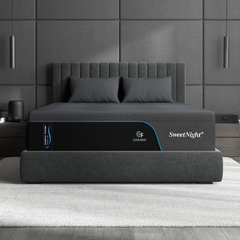
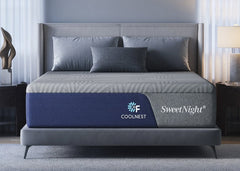
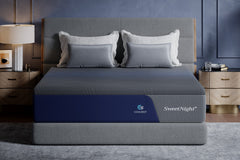
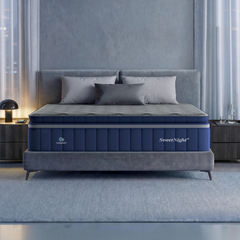
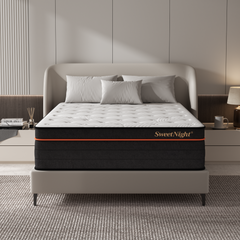
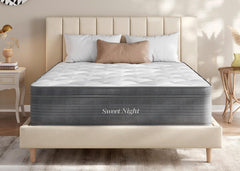
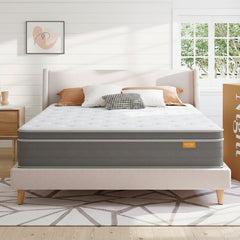
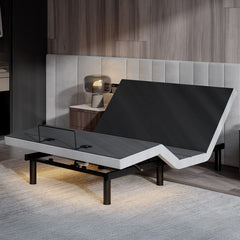






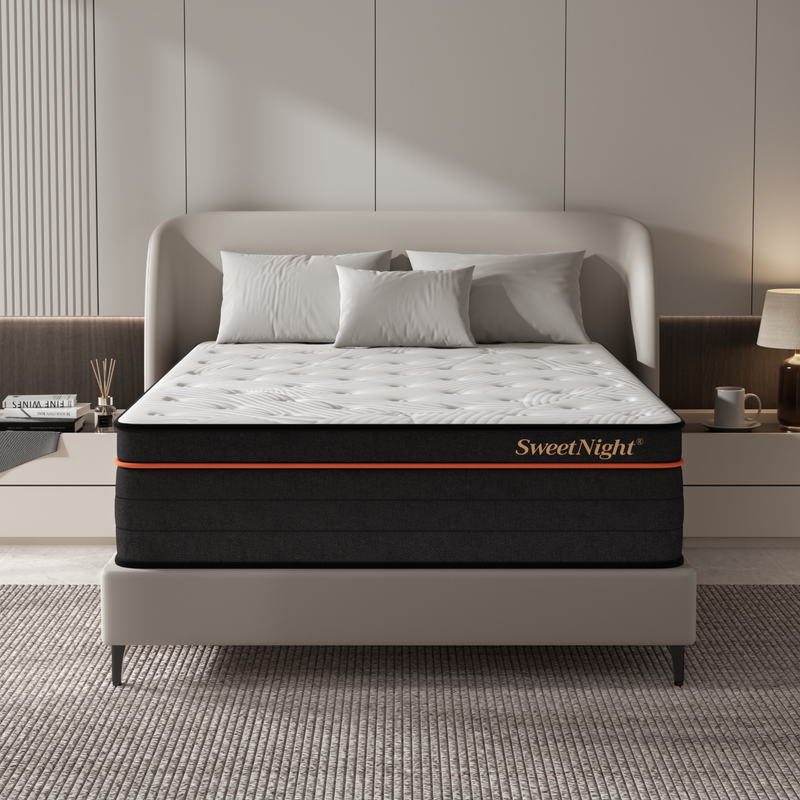
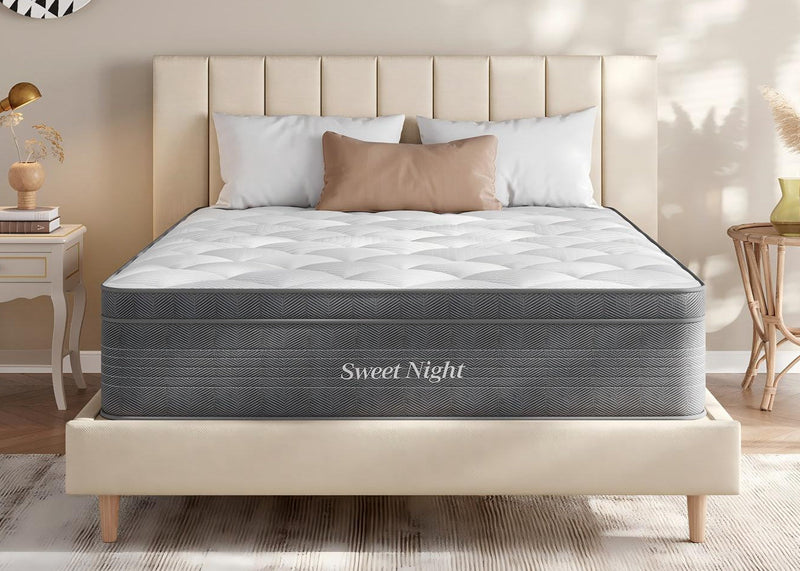
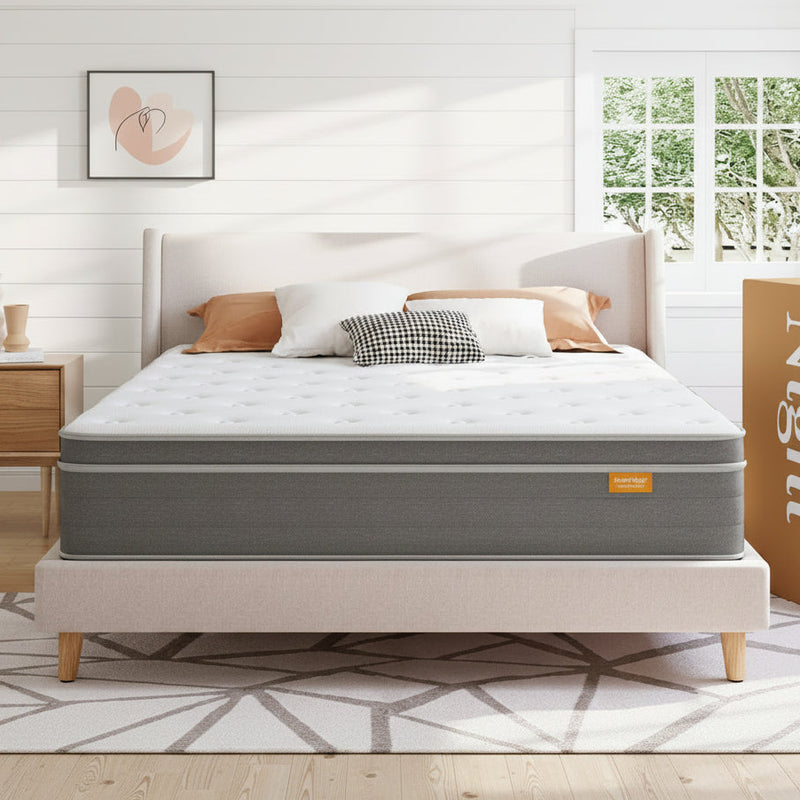
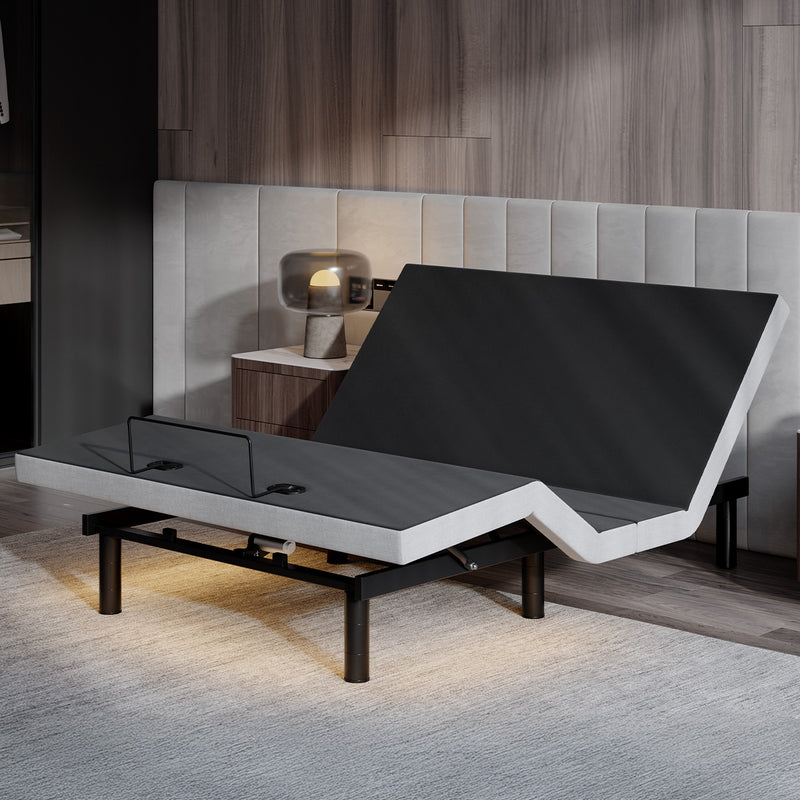





Often, yes. Many hybrid mattresses work on adjustable bases, as long as the coils are individually pocketed, the mattress isn't too tall, and the manufacturer approves adjustable use in writing. What decides it is mechanics: how the coils are joined, what runs around the edge, and how thick the mattress is at the hinge. Some bases are specified for all-foam mattresses only, and our own SenseSync base is one of them.
This is the engineering companion to our broader guide, do you need a special mattress for an adjustable bed. Here we go inside the mattress: the four coil types, the parts that resist a fold, the geometry of thickness, and how to read a compatibility claim without taking it on faith.
What Happens Inside a Mattress When an Adjustable Bed Folds
Picture a mattress as a slab lying across a hinge. When the head section rises, the slab bends. Everything on the inside of the bend, which on an adjustable bed is the top surface you sleep on, has to get shorter. Everything on the outside, the bottom resting on the deck, has to get longer or slide. Somewhere in the middle is a layer that neither stretches nor shrinks.
Foam handles this by doing what foam always does: the top layers squeeze into a soft crease and the bottom layers stretch a little. Sleep Foundation describes the advantage simply: foam can compress when the base bends and then regain its shape when the bed goes flat.
A hybrid has foam on top, but the thickest part of it is usually a spring unit. Steel coils don't compress sideways the way foam does. When the fold arrives, the coils near the hinge have to tilt, lean against each other, or compress unevenly. How freely they can do that depends almost entirely on whether each coil is free to move or tied to its neighbors.
Coil Types Explained: Pocketed, Bonnell, Continuous and Offset
Sleep Foundation's innerspring buying guide defines the main coil systems. Bonnell coils are "molded into an hourglass shape and joined together with wires." Continuous coils are "thin wires running parallel to one another that are joined together on both sides by helical wires." Pocketed coils are "encased in fabric and are designed to move independently," and most hybrids use them.
| Coil system | How it's built | How it responds to a fold | Adjustable-base outlook |
|---|---|---|---|
| Pocketed (individually wrapped) | Each coil sewn into its own fabric pocket; pockets glued or joined in rows | Coils near the hinge can lean and compress one by one | Often workable; needs the maker's approval |
| Bonnell | Hourglass coils tied together with wire | The whole grid resists; bending loads the wire connections | Generally a poor fit |
| Continuous | Rows of wire joined by helical wires on both sides | Behaves as one sheet of steel across the hinge | Generally a poor fit |
| Offset | A variation on the hourglass coil, also laced together into one unit | Like Bonnell: a connected unit that resists bending | Treat like other connected coils |
The pattern is plain once you see it. Sleep Foundation says innersprings made with interconnected coils are "generally less conducive" to adjustable frames "because of the potential stress that can be placed on the coils." Good Housekeeping's testers recommend that any coils in an innerspring or hybrid bed be individually pocketed, and they describe pocketed coils as only "slightly more flexible" than other coil beds, not as flexible as foam. That's a useful calibration: pocketed coils are the best of the coil options, not the equal of all-foam.
One more note on the table: the connection between the pockets matters too. Pockets that are glued or sewn tightly in rows can behave less independently than pockets joined loosely. Most product pages don't say which, and that's worth an email to the maker if you're buying a hybrid for a base.
Border and Edge Support: The Part Nobody Mentions
Coils get the attention, but a mattress also has a perimeter. Many coil mattresses use a firmer ring of coils, a steel border rod or a foam encasement along the sides to stop the edge from collapsing when you sit on it. Whatever that edge system is, it runs the full length of the mattress, which means it crosses the hinge line too.
A foam encasement bends with the rest of the foam. A steel border rod or a ring of heavier edge coils is a different matter: it's the stiffest part of the mattress, and it runs lengthwise, exactly the direction the fold works against. We haven't found published testing on how border systems hold up on adjustable bases, so treat this as reasoning rather than a documented failure rate. It's one of the reasons SweetNight avoided coil units altogether for its own base, and it's a fair question to put to any hybrid maker: what's in the edge, and is it designed to bend daily?
What Resists the Fold, Ranked
Put everything together and you get a rough order of what makes a mattress fight an adjustable base, from most to least important:
- Connected coils. Wire tying coils together turns the spring unit into one stiff sheet.
- Total thickness. More material has to squeeze and stretch at the hinge, and stiffness climbs steeply with height (see the geometry below).
- A stiff perimeter. Steel border rods and heavy edge coils run straight across the fold.
- Dense, firm comfort layers. High-density transition foams bend, but less willingly than softer memory foam.
- Latex. Good Housekeeping notes that latex is less flexible than foam, so you may not reach the base's maximum incline.
A pocketed-coil hybrid under 14 inches with a foam-encased edge sits near the forgiving end of that list. A 16-inch pillow-top with a Bonnell unit and a steel border sits at the other end. Most hybrids fall somewhere between, which is why a model-by-model check beats a rule about "hybrids" as a category.
How Thick Should a Mattress Be for an Adjustable Bed?
There's no industry standard, and you'll see confident-sounding ranges online that don't trace back to anything. The one clear piece of guidance we found comes from Good Housekeeping: tall mattresses, especially those over 14 inches, often don't work well on bases, so check the specifications for any model you're considering. Sleep Foundation adds, without giving a number, that some mattresses may simply be too thick for an adjustable bed.
The market reflects this. Good Housekeeping's sheet testers observe that most mattresses for adjustable beds tend to be below 14 inches, and brands sometimes approve only one height of a model. Good Housekeeping's mattress-for-adjustable-bed roundup notes that for one popular innerspring, only the 11.5-inch version is compatible with an adjustable base, even though taller versions exist.
Thickness also affects comfort, not just compatibility. Heavier sleepers and side sleepers usually want more comfort depth; lighter sleepers often don't need it. Our guide to mattress thickness by body type and sleep position covers that side. For a base, the practical answer is: within the base maker's specification, choose the thickness your body needs, and don't go taller for its own sake.
Thickness Geometry: Why a Thicker Mattress Fights the Fold Harder
This section is an illustration, not a lab test. It uses textbook geometry to show why thickness matters more than it looks.
The length mismatch
When any slab bends through an angle, the top and bottom surfaces trace arcs of different length. The difference equals the thickness multiplied by the bend angle in radians, however sharp or gentle the curve. A mattress has to absorb that difference by crushing the top layers into a crease, stretching the bottom, sliding along the deck, or some mix of all three.
| Mattress thickness | Head at 30° | Head at 45° | Head at 60° | Relative bending stiffness (12" = 1.0) |
|---|---|---|---|---|
| 10" | 5.2" | 7.9" | 10.5" | about 0.6 |
| 12" | 6.3" | 9.4" | 12.6" | 1.0 |
| 14" | 7.3" | 11.0" | 14.7" | about 1.6 |
| 16" | 8.4" | 12.6" | 16.8" | about 2.4 |
The middle columns show the difference in length between the top and bottom surfaces across the fold, for an idealized slab of uniform material. Real mattresses are layered and don't bend as clean slabs, so the absolute figures overstate what any one layer feels. The ratios are the point: at every angle, a 16-inch mattress has about a third more length to lose than a 12-inch one.
The stiffness jump
The last column uses the standard beam rule that a slab's resistance to bending grows with the cube of its thickness. Going from 12 to 14 inches adds about 60 percent more resistance; going to 16 inches more than doubles it. Again, a layered mattress isn't a uniform beam, and soft top foam lowers the real number. But the direction is reliable. Taller mattresses resist the fold disproportionately, which means more of the motor's effort goes into bending the mattress, and the mattress is more likely to round off the angle or lift away from the deck instead of following it.
Add coils to that thickness and the effects stack: a tall slab that is also built from steel is the hardest thing you can ask a base to fold.
Memory Foam Mattress for an Adjustable Bed: Why All-Foam Bends Best
All-foam mattresses make the mismatch above easy. There's no steel to lean or buckle, so the upper layers compress into the crease and the whole slab follows the deck. Good Housekeeping's testers found foam mattresses "the most flexible of the bunch," and memory foam in particular softens and conforms under body heat and pressure, which suits a surface that's being reshaped several times a day.
All-foam also avoids two small annoyances on a moving base. Sleep Foundation notes that all-foam mattresses won't squeak, while innerspring and hybrid mattresses are more prone to noise from their springs, and a base that moves while you're lying on it is exactly when you'd hear it. And foam's even behavior makes the retainer bar's job simpler, because there's no stiff coil unit trying to spring back toward flat.
That doesn't make every foam mattress a good choice. Very dense, firm foam stacks still resist bending, and thickness still matters. If you're weighing foam against coils for feel and motion isolation as well as compatibility, see our memory foam vs hybrid mattress guide.
How to Read a Manufacturer's Compatibility Statement
"Adjustable-base compatible" has no shared definition, so the wording is everything. A few real examples, as published on brand sites in September 2026, show how different these statements can be:
- Tempur-Pedic's help center says any of its mattresses can be used with any of its power bases. That's a clear promise, but only within its own lineup.
- Serta's baselogic product pages say all mattresses sold on Serta.com will work well on the base, and advise owners of other mattresses to ask their maker whether the mattress is "adjustable-friendly."
- Nectar's adjustable frame page says the frame pairs with any of its own mattresses but that it "cannot guarantee" other mattresses will work.
- One innerspring line approves only a single 11.5-inch height for adjustable use, per Good Housekeeping.
Notice that none of these is a blanket promise about hybrids in general. When you read a statement for a specific hybrid, check four things:
- Which model and which height. Approval for the 12-inch version says nothing about the 15-inch version.
- Which bases. "Compatible with our bases" is narrower than "compatible with adjustable bases."
- Whether it's in the warranty. A product-page line is marketing. Warranty language is what you can claim on.
- Any limits. Maximum angles, a required retainer bar, or a rule about not sitting on a raised head section.
Sleep Foundation's advice is the same in fewer words: confirm that the specific mattress can be safely used on an adjustable base, and check that doing so won't affect the warranty. Many hybrids will pass that test. The ones that can't show it in writing are the ones to skip.
Why SenseSync Is Specified for All-Foam 12 to 14 Inches, Not 16
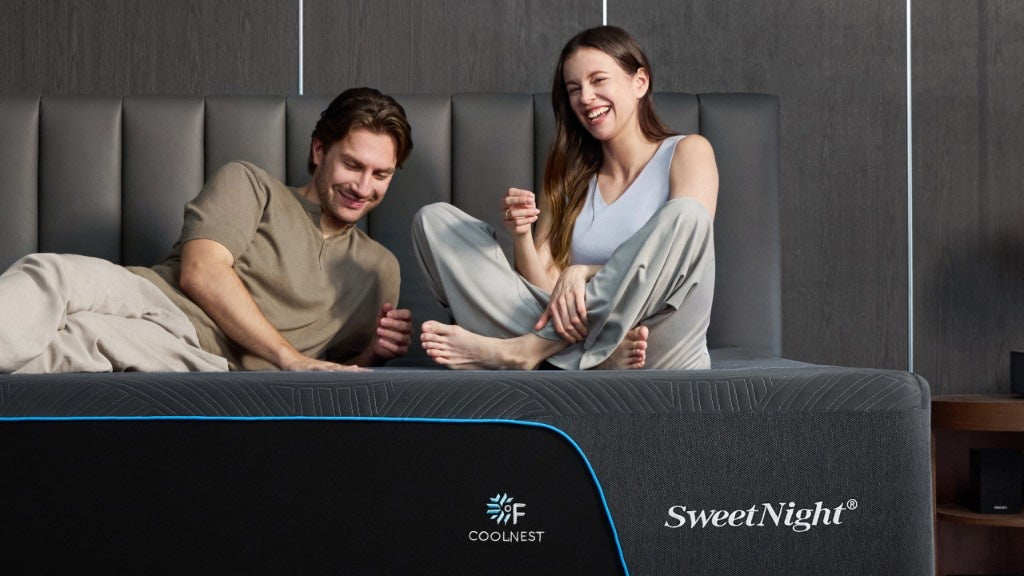
Everything above explains a decision we made about our own base. The SenseSync dual-motor adjustable base is specified for all-foam memory foam mattresses 12 or 14 inches thick. No hybrid, innerspring or pocket-coil mattresses, and no 16-inch mattresses; a Split King takes two Twin XL memory foam mattresses in 12 or 14 inches. (Disclosure: SweetNight makes SenseSync and the CoolNest mattresses.)
The reasoning follows the mechanics. The base folds the mattress at its hinge points every time it moves, including the 60° assisted-sitting position. All-foam bends evenly across that fold. A coil unit resists it, can pull away from the deck, and puts stress on the coils, the edge and the motors. A 16-inch mattress, even all-foam, is much stiffer across the fold, as the stiffness column shows, and it changes how the angle carries through to the sleeping surface and how the mattress rests against the foot retainer bar.
We're not saying hybrids marketed as adjustable-compatible are misrepresented. Sources say many of them work, on many bases. We specified SenseSync around the mattress that bends most predictably, so it can be supported without caveats. That's also why our own lineup splits cleanly. The CoolNest memory foam mattress, CoolNest Pro and CoolNest Ultra pair with SenseSync only in 12 or 14 inches. Our 16-inch versions and the CoolNest Hybrid are built for static frames, not for this base. For specific picks by sleeper type and base size, see our best mattress for adjustable bed guide.
FAQ
Can you put a hybrid mattress on an adjustable bed?
Often, yes, but it depends on the model. Sleep Foundation says many hybrids are compatible with adjustable frames while some have springs that cannot bend without damage. Look for individually pocketed coils, a thickness of 14 inches or less, and a written statement from the maker that covers adjustable bases. Some bases, including SweetNight's SenseSync, are specified for all-foam mattresses only.
What thickness mattress is best for an adjustable bed?
There is no official standard, but most mattresses sold for adjustable beds sit at 14 inches or less, and Good Housekeeping warns that mattresses over 14 inches often do not work well on bases. Always follow the base maker's specification. For the SenseSync base, SweetNight specifies all-foam memory foam mattresses 12 or 14 inches thick.
Is a 16-inch mattress too thick for an adjustable bed?
It can be. A thicker mattress has to compress and stretch more at the fold, and its resistance to bending rises steeply with thickness. If a maker approves a specific tall model for a specific base in writing, that statement is what counts for that pairing. SweetNight does not pair any 16-inch mattress with the SenseSync base, including its own 16-inch CoolNest models.
Can you put an innerspring mattress on an adjustable base?
Traditional innersprings with Bonnell or continuous coils are generally a poor fit, because the coils are wired together and the whole unit resists bending. Sleep Foundation calls interconnected-coil models generally less conducive to adjustable frames. Innersprings with individually pocketed coils can work if the manufacturer approves adjustable use in writing.
Is memory foam or hybrid better for an adjustable bed?
Memory foam is the more forgiving choice. Good Housekeeping's testers found foam the most flexible mattress type, and Sleep Foundation notes foam compresses when the base bends and recovers when flat. A good pocketed-coil hybrid can work too, but it depends on the specific model, so it needs more checking before you buy.