












People search for hotel pillows after a specific experience: a night away, an unusually good sleep, and the realisation that the pillow was doing something the one at home does not. It is a real effect, and it is not caused by hotels buying secretly superior pillows.
What hotels actually do is optimise for a completely different set of constraints than you do — laundry, allergies, cost per room, replacement cycles — and several of those constraints happen to produce a pillow that feels great for one or two nights. Here is what is really on that bed, and which parts of it are worth copying.
Short Answer: What Hotels Actually Put on the Bed
Across the large mid-range and business chains, the pillow on the bed is almost always the same recipe:
- Down alternative fiber fill — polyester microfiber engineered to imitate the loft of down while surviving commercial laundry.
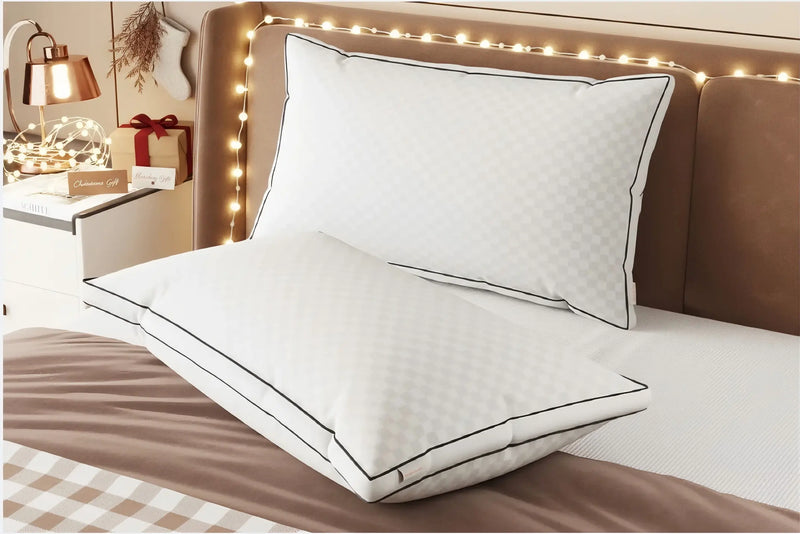
- A gusseted construction, meaning a fabric side wall between the top and bottom panels, which keeps the pillow the same thickness edge to edge.
- Two pillows per sleeper, usually in slightly different firmnesses so a guest can pick or stack.
- A protector under the case that you never see and never think about.
- A relatively new pillow, because hotels replace on a schedule and households do not.
Nothing on that list is exotic. Four of the five are choices you could make this afternoon, and the fifth — replacement frequency — is free.
Why Hotels Rarely Use Real Down
The luxury association is with down, and yet down is the exception rather than the rule. There are four reasons, and they are all operational.
Allergies and guest complaints. A hotel cannot know who is arriving. Fiber fill removes an entire category of complaint at the front desk, and the properties that do stock down almost always keep a hypoallergenic alternative available.
Laundry. Commercial laundering is aggressive: high temperatures, industrial detergent, high-speed extraction. Down survives it poorly and expensively. Polyester fiber is designed to come through it repeatedly.
Cost per room. Multiply four pillows by several hundred rooms, then multiply again by an annual replacement cycle. Down at that scale is a capital decision; fiber is a consumable.
Consistency. A chain wants room 412 to feel like room 108 and like the same brand in another city. Manufactured fiber is uniform in a way a natural product is not.
There is one more that gets overlooked: down is warm. It is one of the best insulators available, which is exactly what you do not want against your head in a room set to a fixed temperature by someone else. Fiber fill breathes more readily and runs cooler.
Down Alternative Fill: What It Is and How It Behaves
Down alternative means fine polyester fibers, usually crimped and siliconised so they slide against each other and trap air the way down clusters do. The good versions are genuinely convincing. The cheap versions are the reason the category has a mixed reputation.
What it does well: it lofts up quickly, it recovers when you move, it is washable, it does not trigger feather allergies, and it costs a fraction of what down does. What it does less well: it compresses under sustained weight, so it feels softer at bedtime than at 4 a.m., and lower grades permanently clump once they have been washed a few times.
The difference between grades is fiber quality — how fine the filaments are, whether they are crimped, and whether they are treated to stay separate. You cannot see any of that in a photograph, but you can feel it: good fiber fill springs back briskly when you compress it in your hand and releases, while poor fill stays dented for a moment.
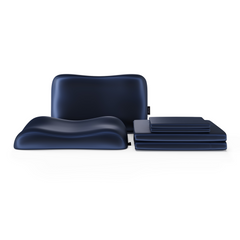
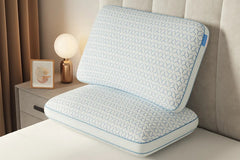
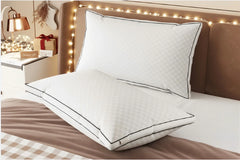
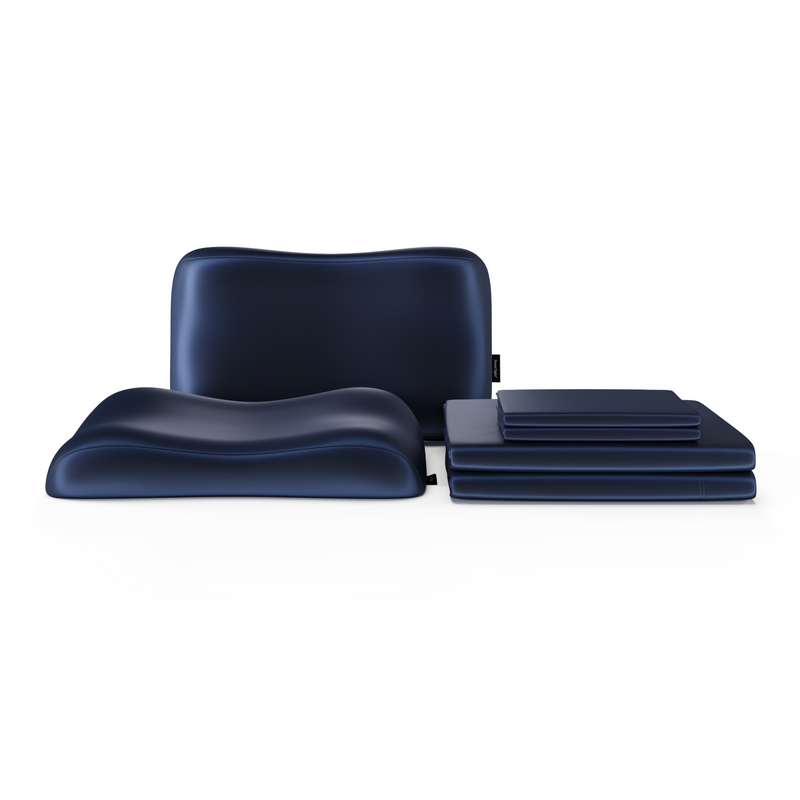
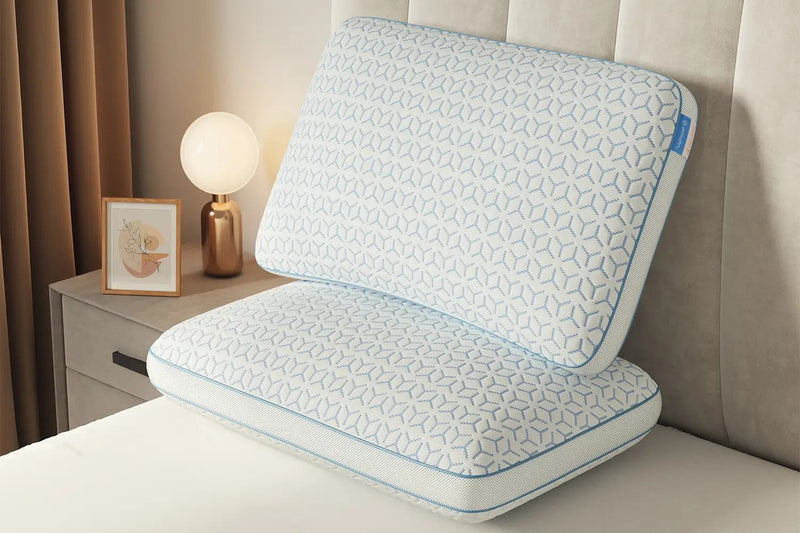
Our own Comfort Pillow 2-Pack is built on this principle, using a resilient premium fiber fill chosen for rebound rather than raw softness, with a dye-free machine washable cover — the same combination of properties that makes fiber the default choice in hotels.

The Gusset: The Structural Detail That Creates That "Plump" Look
This is the part that most explains why a hotel pillow looks the way it does, and hardly anyone knows the word.
An ordinary pillow is two panels of fabric sewn together at the edges. The consequence is geometric: the fill has room in the middle and nowhere to go at the perimeter, so the pillow is thick in the centre and tapers to nothing at the sides. It looks like a flying saucer.
A gusseted pillow adds a fabric side wall — typically an inch or two tall — between the top and bottom panels. That wall gives the fill a defined volume all the way to the edge, so the pillow keeps its thickness from side to side. It is what produces the boxy, upholstered look you see on a made hotel bed.
The functional consequences matter more than the look. Even loft means your head is supported the same amount wherever it lands on the pillow, which is exactly what a person who moves at night needs. Edge support means the perimeter does not collapse when you sleep near it. And consistent height means the pillow you measured for is the pillow you get at every point on its surface.
The gusset is also the detail most often skipped on inexpensive pillows, because a side wall is extra fabric and an extra seam. Ours has one, which is why it holds an even thickness rather than mounding in the middle.
Why Hotel Pillows Come in Pairs
Four pillows on a double room is not styling. It is how a hotel answers a question it cannot ask.
Guests need different heights, and nobody at check-in is going to interview you about your shoulder width. Two pillows per person covers most of the range: use one if you sleep low, stack both if you sleep high, fold one under the other for something in between. The stack is the important part — it is the closest thing to adjustable loft that requires no adjustment.
Pairs also solve a rotation problem. One pillow can be in the laundry while the other is on the bed, so the room never goes out of service. And a pair keeps a bed looking symmetrical, which matters more in photographs than it does in your bedroom.
The reason to copy this at home is the same reason it works in hotels: you get a stack when you want height, a spare when one is in the wash, and a second option when your usual position changes. It is also why pillows are commonly sold in twos rather than ones.
If you share a bed, one caveat. Buy two pillows, but do not assume both people need the same one. Loft depends on shoulder width and sleeping position, and a matched pair serves whichever of you is closer to average.
The Pillow Protector Nobody Sees
Between the hotel pillow and the pillowcase there is almost always a zippered protector. It is invisible, it costs very little, and it is a large part of why hotel pillows stay in usable condition.
What it stops is the slow contamination of the fill: sweat, skin oils, hair products, and the moisture your head releases every night. Fill that never takes on any of that stays lofty and odour-free for years. Fill that absorbs it gradually gets heavier, clumps, and develops the yellow staining most people discover only when they strip a pillow after five years.
At home the protector does one more thing hotels do not need it for: it means you can wash the layer that touches the pillow without washing the pillow itself. That matters most for pillows whose fill cannot go in a machine.
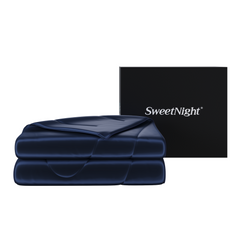
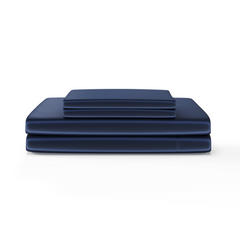
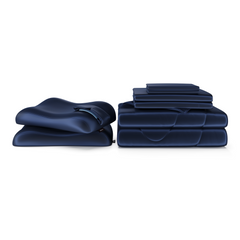
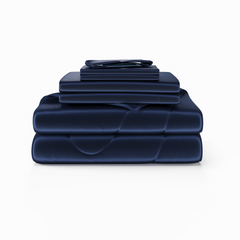
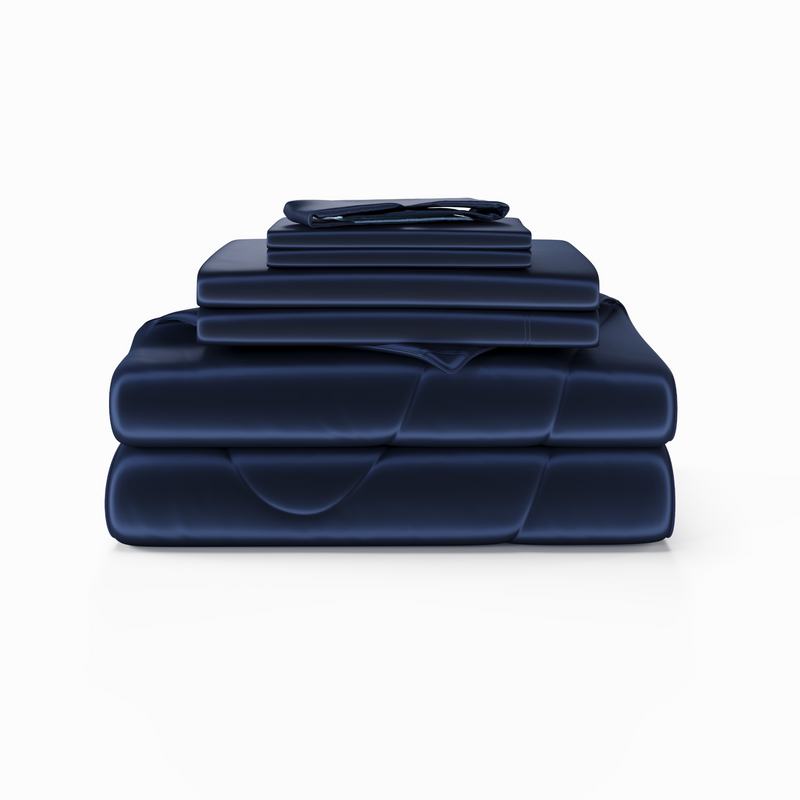
The complete hotel bed is a stack of layers, each of which can be laundered on its own schedule — protector, case, sheet, and the flat sheet that takes the wear that would otherwise reach the comforter. Matching cases to the sheets is part of the effect, which is why sheet sets such as our cooling sheet set include two pillowcases cut from the same fabric rather than leaving you to find a match.

How to Get the Look and the Support at Home
A checklist you can actually execute.
- Buy gusseted. Look for a visible side panel in the product photos. This is the single detail that most changes how a pillow looks and how evenly it supports.
- Buy in pairs. Two per sleeper if you have the room. Stacking is free height adjustment.
- Add a protector. Under the case, on every pillow. It is the cheapest life-extension available.
- Match the case to the sheets. Hotel beds read as coherent because everything is from the same set, not because any single item is remarkable.
- Size deliberately. Standard, Queen and King are 26, 30 and 36 inches long and the choice changes how the bed looks as much as how it sleeps. Our pillow sizes guide has the full chart.
- Fluff daily. Ten seconds when you make the bed. Fiber fill responds to it immediately, which is why hotel pillows look plump at 3 p.m. every day.
- Replace on a schedule. This is the one people skip, and it is the biggest single factor. A hotel pillow is usually less than a year or two old.
Where Hotel-Style Pillows Fall Short
A hotel optimises for a guest who stays two nights. You are optimising for three hundred and sixty-five.
Soft fiber fill compresses under a heavy head. Over a couple of nights that reads as luxurious. Over a couple of years it reads as a flat pillow, because fiber does not recover indefinitely.
It is not a support product. A soft, evenly lofted pillow holds your head up; it does not hold the curve of your neck in a specific position. If you wake with a stiff neck most mornings, a plusher pillow is unlikely to be the answer, and a shaped one might be. That is a different category, covered in our guide to choosing a cervical pillow.
Side sleepers can be underserved. Broad shoulders create a gap that a compressible pillow struggles to fill, which is why the same hotel bed can feel wonderful on your back and stiff on your side.
It says nothing about temperature. Fiber breathes better than solid foam, but no fiber pillow actively moves heat. If you overheat around the head and neck, the pillow's fill is only one part of the problem and the surfaces around it — case, sheets, room — matter as much. The cooling bedding range is built around that idea.
How to Keep Them Fluffy (Washing and Re-lofting)
Fiber pillows are the most maintainable type, and almost all of the maintenance is drying rather than washing.
Daily. Ten seconds of shaking and patting when you make the bed. Fiber redistributes easily and this alone prevents most of the settling.
Weekly. Wash the case. The case takes almost everything a pillow is exposed to, so a fresh one does more for how the pillow feels than any deep clean.
Every few months. Wash the protector and, if the care label allows it, the pillow itself. Two pillows at a time keeps a top-loading machine balanced. Use less detergent than feels right — residue trapped in fill is what makes a washed pillow feel stiff.
Drying is where it goes wrong. Fill that is not bone dry in the core clumps permanently and can smell within days. Dry on low for considerably longer than seems necessary, add a few clean dry towels to keep the fill tumbling, and squeeze the middle of the pillow before you call it done. If the centre feels even slightly cool or heavy, it is still wet.
When a fiber pillow no longer recovers after all of this — it stays flat, the fill has gone into permanent lumps, and it feels heavier than it used to — that is the end of its life rather than a cleaning problem. Copying the hotel replacement cycle is the last piece of the puzzle.
FAQ
Why do hotel pillows feel soft but not flat?
Two structural reasons. A gusseted side panel holds an even thickness edge to edge instead of letting the pillow taper. And hotels put two pillows per sleeper, so you are often lying on a stack — soft at the surface, supported underneath.
Do hotels use down or down alternative?
Mostly down alternative fiber. It survives commercial laundry, avoids allergy complaints, costs far less on a replacement cycle, and behaves identically across hundreds of rooms. Luxury properties may offer down on request, but the pillow already on the bed is usually fiber.
How often do hotels replace pillows?
Typically somewhere between six months and two years depending on the property, with many chains on an annual cycle. That turnover is a large part of the experience — you are almost always sleeping on something relatively new.
Can you machine wash a fiber pillow at home?
Usually, but check the care label. The failure point is drying: fill that stays damp in the core clumps and smells. Dry longer than you expect, on low, with clean dry towels in the drum to keep it moving.
How many pillows should be on a bed?
Two per sleeper is the hotel standard, and it is practical rather than decorative — stack for height, use one and set the other aside, or prop up to read. The same logic is why pillows are sold in pairs.
Are hotel pillows good for side sleepers?
Not automatically. Soft fiber compresses under the head, so a broad-shouldered side sleeper can end up short of loft with the neck bending toward the mattress. It is why the same bed can feel perfect on your back and stiff on your side.