































A cervical pillow is one of the few sleep products where the shape does something specific and measurable. It is also one of the easiest to buy wrong, because the thing that decides whether it works is not the brand or the foam — it is whether the height under your neck matches the distance between your neck and the mattress. Get that number right and morning stiffness often fades within two weeks. Get it wrong by an inch and the same pillow will make your neck feel worse than the flat one you replaced.
This guide is about that number, and about the handful of situations where a contoured pillow is the wrong answer entirely.
Short Answer: Who a Cervical Pillow Helps and Who It Hurts
A cervical pillow — also sold as a contour pillow or an ergonomic pillow for neck pain — is a shaped pillow with a raised roll that sits under the curve of your neck and a lower hollow that cradles the back of your head. The point is to stop your head from tipping back or dropping forward while the muscles at the base of your skull are supposed to be off duty.
It tends to help:
- Back sleepers who wake up with a stiff, tight band across the base of the skull. This is the classic case: a flat pillow lets the head roll back, a fat pillow pushes the chin toward the chest, and the contour sits between the two.
- Side sleepers who are using a pillow that is too low. The shoulder creates a gap that a soft, collapsing pillow simply cannot fill.
- Combination sleepers who change position two or three times a night and keep waking up in a bad one because a squashy pillow no longer supports anything by 2 a.m.
- People whose neck pain is worst in the first hour after waking and improves as the day goes on. Pain that follows that pattern is usually about sleeping position, not something you did at your desk.
It tends to hurt:
- Stomach sleepers. Any raised neck roll forces the neck further into extension. Stomach sleepers need the flattest pillow they can tolerate, or none at all.
- People who read or watch TV in bed for an hour before sleeping. A contour is designed for one head position, and sitting propped up against it is not that position.
- Anyone who buys a fixed height without measuring. A contour pillow that is an inch too tall is worse than a flat pillow, because you cannot squash it back down.
If you have been diagnosed with a disc problem, arthritis in the cervical spine, or you have neck pain with numbness, tingling or weakness in an arm, treat pillow shopping as a comfort decision and take the medical question to a clinician. No pillow is a treatment.
What a Cervical Pillow Actually Is
Strip away the marketing and a cervical pillow is defined by its cross-section. Cut one in half and you see a wave: a high ridge at the edge where your neck goes, a dip in the middle where the back of your head sits, and often a second, lower ridge on the far edge. That is it. Everything else — the foam type, the cover, the gel — is about how long the shape survives the night and how it feels while it does.
The reason the shape matters is that your head and your neck are different weights sitting at different heights. A human head is roughly ten to eleven pounds. Your neck weighs almost nothing by comparison. Put both on a uniform flat pillow and the heavy part sinks while the light part floats, which is the exact opposite of what your cervical spine wants. The dip-and-ridge profile inverts that: it gives away under the skull and pushes back under the neck.
Most contour pillows come in one of three constructions. Solid moulded memory foam holds the shape best and is the most common. Latex holds a similar shape with more bounce and less sink. Shredded fill in a contoured shell is the softest and the least reliable, because the fill migrates out of the neck roll over a few months and the profile flattens.
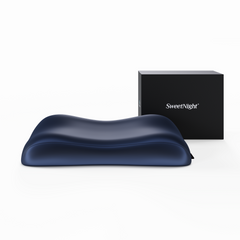
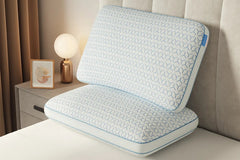
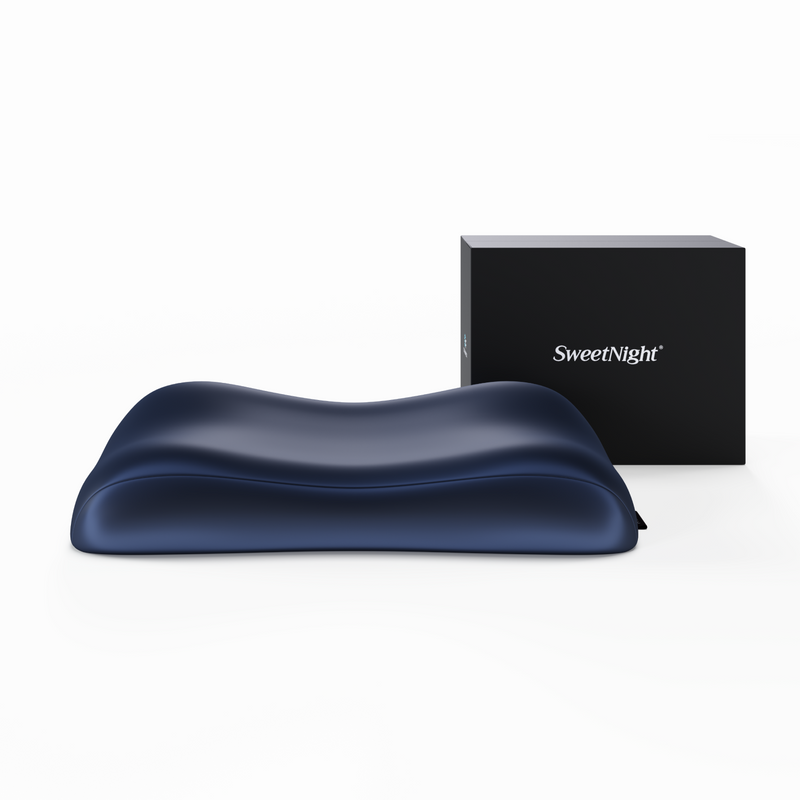
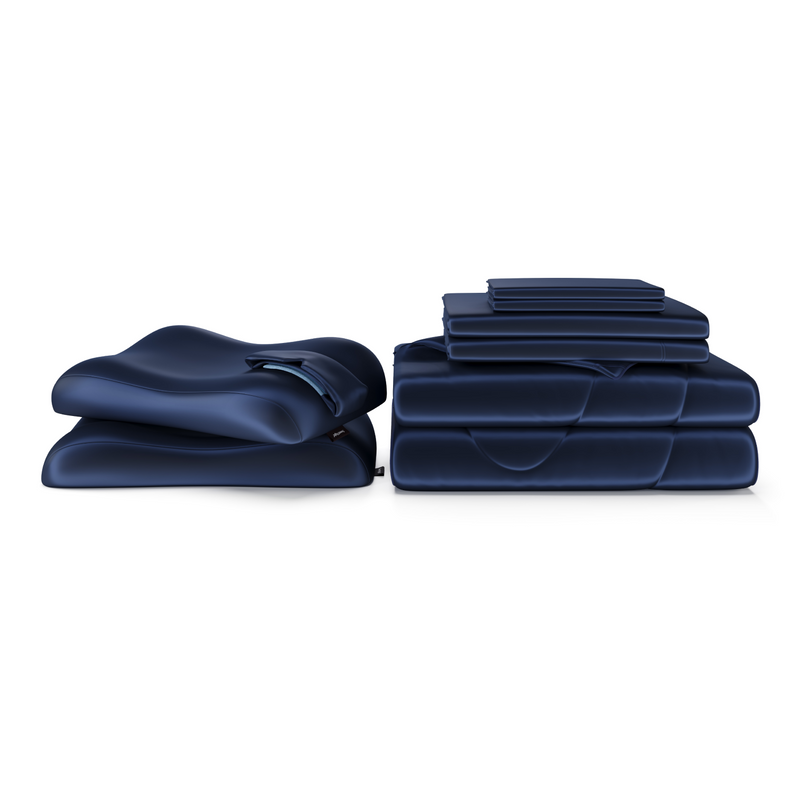
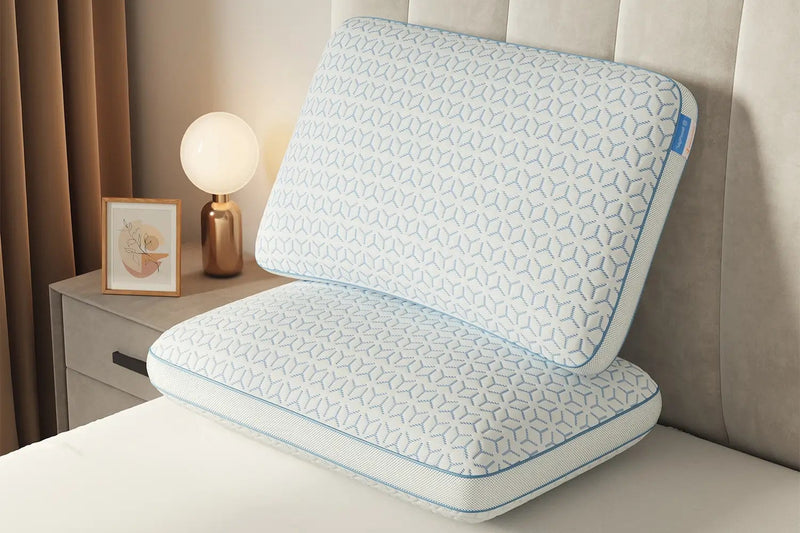
Our own take on this is the CoolNest® Ergonomic Cooling Pillow, which uses an adaptive ergonomic memory foam core under three functional layers: a 420-Pod Cooling Matrix™ sitting directly on the core surface, a breathable mesh cover for airflow between layers, and a CoolGlide™ cool-touch pillowcase on the outside. The measured footprint is 25.2 by 14.6 inches, with a center height of 3.9 inches on one face and 3.1 inches on the other, and edge heights of 5.1 and 3.9 inches. Those four numbers are the whole product decision, and we will come back to them.

Why Your Neck Hurts in the Morning: The Alignment Problem
Your cervical spine has a natural forward curve, called a lordosis. Standing up, the muscles at the front and back of your neck hold that curve without you thinking about it. Lying down, those muscles are supposed to switch off. If the pillow does not hold the curve for them, they either stay switched on all night or the joints and soft tissue take the load instead. Both produce the same result at 7 a.m.: stiffness, reduced range of motion, and that specific ache that runs from the base of the skull into the top of the shoulder.
There are three ways a pillow gets this wrong.
Too low. On your back, your head tips backwards and your chin points at the ceiling. On your side, your head drops toward the mattress and your neck bends sideways all night. The side-sleeping version is the more painful of the two, and it is far more common than people think, because a pillow that felt right when it was new loses an inch of loft in its first year.
Too high. Your chin gets pushed toward your chest. This one is sneaky because it often feels supportive when you first lie down. It tends to show up as tightness at the back of the neck and, in some people, as a jaw or headache pattern rather than as neck pain.
Right height, wrong shape. This is the case a contour pillow is built for. A flat pillow can have exactly the correct average height and still leave a hollow under your neck, because it supports the skull and nothing else. The neck is unsupported in mid-air, and the muscles bridge the gap for eight hours.
The word people use when this is happening is "tension," and it is usually accurate. If you catch yourself unconsciously tucking a hand or a folded corner of the pillow under your neck at night, your body has already diagnosed the problem for you.
The Height Math: How to Size a Pillow to Your Body
Here is the part almost no product page tells you: the correct pillow height is a body measurement, not a preference.
For side sleeping, the height you need is roughly the horizontal distance from the outside of your shoulder to the side of your neck — the gap the pillow has to fill so your head stays level with your spine. Measure it directly: stand with your back and the back of your head flat against a wall, and have someone measure from the wall to the outer point of your shoulder. Most adults land somewhere between four and six inches. Broad-shouldered sleepers and anyone above about 5'10" are usually at the top of that range or past it.
For back sleeping, the number is much smaller: the depth of the hollow between the back of your head and the wall when your posture is neutral. That is typically two to four inches, and it is why the same person needs noticeably different loft depending on position.
Then subtract for sink. A soft mattress lets your shoulder drop into the surface, which reduces the gap the pillow has to fill by roughly half an inch to an inch. A firm mattress does the opposite. This is the single most common reason a pillow that worked in one bed fails in another, and it is why buying a new mattress and keeping the old pillow so often ends in a stiff neck.
A dual-height contour pillow exists to cover this spread without you owning two pillows. On the CoolNest design, the two faces give you 3.9 inches and 3.1 inches at the center and 5.1 inches and 3.9 inches at the edge — so by flipping the pillow you shift the whole profile by about 0.8 inches, and by moving between the center hollow and the outer roll you shift it by another inch or so. That covers most adults between a firm mattress and a plush one. It does not cover everyone, and a very broad-shouldered side sleeper on a firm mattress may still need more loft than any single contour pillow provides.
If you want the underlying theory rather than the measurements, we have a longer piece on pillow loft that covers how height interacts with firmness and fill type across every pillow category.
Side, Back and Combination Sleepers Need Different Lobes
A contour pillow is not one surface. It is usually four, and most people only ever use one of them.
Side sleepers belong on the tall edge, with the neck roll filling the gap under the neck and the shoulder staying off the pillow entirely on the mattress. The test is simple: lie down, then have someone look at you from the front. A straight line should run down the middle of your forehead, your nose and your sternum. If your head is tilted toward the mattress, you need more height. If it is tilted toward the ceiling, less.
Back sleepers belong in the center hollow with the lower roll under the neck. The test here is your chin: it should sit level with or very slightly below your forehead. Chin pointing up means too low; chin tucked toward the chest means too high.
Combination sleepers are the reason dual-height pillows sell. If you start on your back and finish on your side, you want a pillow where rolling ninety degrees also moves you from the low center to the high edge without waking up to rearrange anything. That is exactly what the wave profile does — the center is the back-sleeping zone and the edges are the side-sleeping zones, and your body finds them without instruction after the first few nights.
Side sleepers should also be honest about where the pain actually is. If the ache is in the shoulder joint rather than the neck, the pillow is only half the story and the mattress is the other half. We covered that pattern in detail in a separate piece on shoulder pressure for side sleepers, and it is worth reading before you spend money on a pillow that cannot fix a surface problem.
When a Contour Pillow Makes Things Worse
Retailers rarely publish this list, which is a shame, because it is the difference between a return and a happy customer.
You sleep on your stomach. Stomach sleeping already rotates your neck close to its end range and extends it backwards. Adding a raised neck roll increases both. If you sleep face-down and your neck hurts, the pillow to try is a very thin one, or a folded towel, or nothing.
Your shoulders are unusually narrow or unusually broad. Contour pillows are moulded to a single set of dimensions. Someone with narrow shoulders on a plush mattress may find every contour pillow on the market too tall, and someone with very broad shoulders may find them all too short. In both cases an adjustable pillow you can add fill to or take fill out of is a better fit than a fixed shape.
You have an existing cervical spine diagnosis. Disc herniation, spinal stenosis, facet joint arthritis and post-surgical necks all have specific positioning needs, and some of them are the opposite of what a standard contour provides. Ask the person treating you before you change anything.
You need to sleep propped up. Reflux, sleep apnea managed with an elevated head, late pregnancy — these need an inclined surface, not a contoured flat one. A contour pillow on top of a wedge usually creates too much height.
You cannot stop yourself from folding the pillow. Some people are pillow-folders. If you habitually double a pillow under your head, a moulded contour will frustrate you every single night.
Memory Foam Density and Why Cheap Contour Pillows Collapse
Here is the failure mode nobody warns you about. You buy a contour pillow, it works for a couple of months, and then the neck pain quietly comes back. You assume you got used to it or that the original problem was never the pillow. What actually happened is that the neck roll lost height.
Memory foam holds shape through density and cell structure. Low-density foam feels identical to high-density foam in a showroom or on day one at home — the difference only shows up under a few hundred hours of load. The area that fails first is exactly the area you care about: the raised neck roll, because it carries concentrated pressure over a small surface. Lose half an inch there and your carefully measured height is wrong again.
Three things to look for when you cannot test durability directly:
- A moulded core, not a cut one. Moulded foam has a denser skin on the surface that resists compression at the ridge.
- Foam certification. CertiPUR-US® and OEKO-TEX® Standard 100 do not measure density, but they do tell you what is and is not in the foam, and manufacturers who bother with certification usually bother with foam grade too.
- Recovery time you can feel. Press your palm into the neck roll for ten seconds and release. Foam that springs back instantly is too resilient to hold a contour; foam that takes more than about eight seconds is likely to feel stiff and slow in cold rooms. Somewhere in between is the target.
Shredded-fill contour pillows deserve a specific warning. They are comfortable, but the fill migrates. Within a few months the neck roll is thinner than the head hollow, which is the reverse of the intended profile. If you like adjustability, buy an adjustable pillow on purpose rather than a contour pillow that turns into one.
Heat Is a Hidden Cause of Neck-Pillow Failure
This one surprises people. A contour pillow only works while your head is in the contour. Every time you flip, roll or lift your head off the pillow, the alignment resets — and the most common reason people move their heads at night is not discomfort, it is temperature.
Memory foam is a closed-cell material with a lot of surface contact. It traps the heat your head produces, and your head produces more of it than most people realise, because the scalp is well supplied with blood vessels and it is one of the few parts of your body not covered by a duvet. The classic pattern is a sleeper who wakes at 3 a.m., flips the pillow to the cool side, sleeps another hour and wakes again. Each flip is a fresh chance to end up off the contour with your neck unsupported.
So a cooling layer on a cervical pillow is not a luxury add-on — it is what keeps the geometry doing its job. On the CoolNest pillow the heat management is stacked in three parts: 420 gel pods integrated directly onto the core surface to pull warmth away from the point of contact, a breathable mesh layer that lets air move between the core and the cover instead of sitting still, and a CoolGlide™ cool-touch pillowcase in an 82% nylon and 18% spandex blend that feels cold on first contact and stretches with the contour instead of bridging over it.
The honest framing is this: a cooling pillow does not lower your body temperature. It moves heat away from the surface faster than a plain foam pillow does, which reduces the number of times you feel the need to move. Fewer moves, more hours in alignment.
How to Transition to a Cervical Pillow (the First Two Weeks)
Almost every bad review of a contour pillow is written on night three. That is genuinely the worst night, and it is worth planning for.
Nights 1–3. Expect it to feel odd and possibly worse. Your neck has adapted to whatever position it has been held in for years, and the muscles resist being repositioned. Some people report a mild ache at the base of the skull. This is common and usually fades.
Nights 4–7. Try both faces and both zones. Two nights on each combination is enough to tell them apart. Pay attention to how you feel in the first fifteen minutes after standing up, not how the pillow feels when you lie down — comfort at bedtime and support at 6 a.m. are only loosely related.
Nights 8–14. Settle on one configuration and stay with it. If mornings are improving, you have your answer. If nothing has changed at all by night fourteen, the height is the variable to change, not the pillow type.
A few practical points. Keep the old pillow out of the bedroom for the trial period, because reaching for it at 3 a.m. resets the clock. Do not stack the contour pillow on top of anything. And do not judge it after a night where you were sick, drinking, or asleep on a sofa — you are trying to isolate one variable.
If the pillow arrives compressed in a roll, give it a full 24 to 48 hours to expand before your first night. A foam core that has not finished expanding is measurably shorter than the specification, which sabotages the exact number you were trying to hit.
How to Choose: a 6-Point Checklist
Run a candidate pillow through these six questions before buying.
- Does the listing publish actual heights? Not "medium loft" — inches, for both the neck roll and the head hollow. If a brand will not tell you the two numbers that decide whether the product works, that is information in itself.
- Do those heights match your measurement? Shoulder-to-neck distance for side sleeping, head-to-wall depth for back sleeping, adjusted for how much your mattress lets your shoulder sink.
- Is there more than one usable height? A dual-height design covers a range instead of a point, which matters a great deal if you change positions during the night or if you are between sizes.
- Is the core moulded memory foam or latex, rather than shredded fill in a contour shell? Fixed geometry needs a material that holds fixed geometry.
- Is there a real heat strategy? Gel pods, an open mesh layer, a cool-touch cover — ideally more than one, because a cover alone stops feeling cool once it warms to skin temperature.
- Can the cover come off and go in the machine? Faces, hair products and night sweat all end up on a pillow. On the CoolNest cover the instructions are a gentle cycle below 104°F, tumble dry low below 130°F, and no dry cleaning, ironing or bleaching — hot water and a hot dryer are what kill cool-touch finishes.
Two smaller points worth weighing. Buying in a two-pack costs less per pillow and gives you a spare while one cover is in the wash, which is why the CoolNest pillow is sold as a single or a double pack between $79.99 and $129.99. And the surface area matters if you move around: at 25.2 by 14.6 inches there is room to shift a few inches sideways without falling off the contour, which is not true of the smaller travel-sized contour pillows.
When It Is Not the Pillow: Mattress and Posture
A pillow can only work with what the mattress gives it. If your shoulder sinks four inches into a soft surface, the gap the pillow needs to fill shrinks; if the surface is rigid, the gap grows. Change the mattress and you change the correct pillow height, which is why "my new bed gave me neck pain" is usually a pillow problem in disguise.
The clearest sign that the mattress is the real variable: your neck feels fine on your back but hurts after a night on your side, no matter which pillow you use. That pattern points to a surface that is not letting the shoulder in, and no amount of pillow tuning fixes it. Side sleepers with that problem should start with the best mattress for side sleepers and re-measure their pillow height afterwards.

Daytime posture matters too, and it is the part people most want to skip. Neck pain that is present all day, that is worse by evening, or that came on after a change in your desk setup, is unlikely to be solved by anything you sleep on. Pain that is worst on waking and eases within an hour is the profile that responds to a pillow change.
There is also a plain temperature story. If you overheat every night, the neck pillow is only one layer of a bed that is working against you. Sheets, comforter weight and even light exposure all feed the same problem of interrupted, restless sleep. If that sounds like your bed, the cooling bedding range is built around the same CoolGlide™ fabric and the same idea — move heat away from the surfaces you actually touch.

FAQ
Which end of a dual-height cervical pillow goes up?
The taller lobe goes under your neck when you sleep on your side, because your shoulder lifts your head further off the mattress. The lower lobe is the back-sleeping side. Try both for two or three nights each and keep the one that leaves the least morning stiffness. A dual-height design like the CoolNest pillow gives you four usable heights — 5.1 and 3.9 inches at the edges, 3.9 and 3.1 inches at the center — by flipping and rotating a single pillow.
How long does it take to get used to a cervical pillow?
Seven to fourteen nights for most people. The first three or four nights often feel worse, because the contour holds your head in a position your muscles are not used to. Still stiff after two full weeks? The height is wrong for your shoulder width, not the concept.
Can side sleepers use a cervical pillow?
Yes, and side sleepers usually need the most height of anyone. The gap between your ear and the mattress is roughly your shoulder width, so broad-shouldered side sleepers may need five inches or more. The common mistake is lying on the low center channel, which is the back-sleeping zone, and concluding the pillow is too flat.
Do you put your shoulders on a cervical pillow?
No. Your shoulder stays on the mattress and the pillow starts where your neck starts. Pushing your shoulder onto the pillow tips your head forward and cancels out the alignment. If there is a gap under your neck, move the pillow down toward your shoulders rather than your shoulders up onto the pillow.
Can you wash a cervical pillow?
The cover yes, the foam core no. Memory foam soaks up water, takes days to dry and degrades internally. Wash the removable cooling case on a gentle cycle below 104°F, tumble dry low below 130°F, and skip dry cleaning, ironing and bleach. Spot clean the core and air it out.
What is the difference between a cervical pillow and a regular memory foam pillow?
A regular memory foam pillow is a rectangle that compresses most under the heaviest part of your head. A cervical pillow is shaped before you lie on it — a raised roll under the neck, a lower hollow for the head — so the curve of your neck stays supported instead of collapsing to the same level as your skull.
Does a cooling layer really matter on a neck pillow?
More than it sounds. A contour only works while your head is in it, and heat is the main reason people lift and flip their heads at night. Gel pods, a mesh layer and a cool-touch cover reduce how often that happens. They do not lower your body temperature — they move surface heat away faster.
Is a cervical pillow worth it if my mattress is old?
Partly. A sagging mattress changes how far your shoulder drops, which changes the pillow height you need, and it will keep changing as the sag deepens. If the bed is visibly dipped, fix that first or you will be re-measuring every few months.