











Why Some Rooms Trap Heat: The Thermal Physics
Heat-trapping rooms share common architectural and physical characteristics that create thermal accumulation.
COMMON HEAT-TRAPPING SCENARIOS
1. TOP-FLOOR BEDROOMS
• Heat rises through entire house
• Roof absorbs solar heat during day
• Attic space (if present) acts as thermal mass
• Ceiling radiates heat downward into bedroom
• Result: 5-10°F warmer than first floor
2. CORNER ROOMS
• Two exterior walls (vs one for interior rooms)
• More surface area exposed to outdoor heat
• Limited cross-ventilation (windows on same side)
• Heat enters from multiple directions
• Result: Poor heat dissipation
3. ROOMS ABOVE GARAGES
• Garage heats up during day (dark concrete, sun exposure)
• Heat radiates upward through floor
• Often poor insulation between garage and bedroom
• Result: Heat source below room
4. WEST-FACING ROOMS
• Afternoon/evening sun (2-8 PM, peak heat)
• Solar heat gain through windows at hottest part of day
• Room accumulates heat right before bedtime
• Result: Bedroom at peak temperature when trying to sleep
5. SMALL ROOMS WITH INADEQUATE VENTILATION
• Limited air volume
• Heat accumulates in enclosed space
• Single window or no windows
• Air conditioning can't reach effectively
• Result: Stagnant hot air
THE THERMAL ACCUMULATION PROBLEM
How heat traps in rooms:
Daytime (10 AM - 6 PM):
• Solar radiation heats exterior walls
• Heat conducts through walls into room
• Room temperature rises 2-3°F per hour
• By 6 PM: Room is 80-85°F
Evening (6 PM - 10 PM):
• Outdoor temperature drops slightly
• But room has accumulated thermal mass
• Walls, ceiling, floor are all warm
• They continue radiating heat into room
• Room temp drops slowly (1°F per hour)
Bedtime (10 PM - midnight):
• Room still 78-82°F
• Your body generates additional 300-400 BTU/hour
• Mattress traps this body heat
• Room temperature actually increases 1-2°F overnight
Morning:
• Room peaked at 82-84°F overnight
• You experienced 8 hours of heat stress
• Sleep quality destroyed

MEASUREMENT: ROOM TEMPERATURE PROFILES
Temperature tracking in heat-trapping room (no AC, summer):
Time | First Floor | Top Floor (Heat-Trapping Room) | Difference
---|---|---|---
8 AM | 72°F | 74°F | +2°F
2 PM | 76°F | 82°F | +6°F
6 PM | 78°F | 84°F | +6°F
10 PM (Bedtime) | 75°F | 82°F | +7°F
2 AM | 73°F | 81°F | +8°F
6 AM | 72°F | 80°F | +8°F
The heat-trapping room stays 6-8°F warmer 24/7. This is where mattress breathability becomes critical.
THE MATTRESS HEAT CONTRIBUTION
In a heat-trapping room, your mattress can either:
• Add 8-12°F to surface temperature (bad)
• Add 2-3°F to surface temperature (acceptable)
With non-breathable mattress:
• Room ambient: 82°F
• Mattress surface: 82°F + 10°F = 92°F
• You experience: 92°F sleeping surface
• Result: Impossible to sleep comfortably
With breathable cooling hybrid:
• Room ambient: 82°F
• Mattress surface: 82°F + 2°F = 84°F
• You experience: 84°F sleeping surface
• Result: Tolerable with fan assistance
The 8°F difference is the difference between miserable nights and manageable sleep.
WHAT HAPPENS WITHOUT BREATHABLE MATTRESS
Sleep Disruption Pattern:
Hour 1: Warm but falling asleep
Hour 2: Starting to feel hot, slight discomfort
Hour 3: Waking up hot, repositioning
Hour 4: Waking up again, struggling to stay asleep
Hour 5-8: Repeated awakenings, fragmented sleep, exhaustion
With Breathable Cooling Hybrid:
Hour 1-8: Consistent manageable temperature, minimal awakenings, restorative sleep
The mattress choice determines whether the room is livable or unbearable.

Breathability Engineering: Maximizing Airflow Through Mattress
"Breathability" means air can flow through the mattress structure, carrying heat away. Here's how to engineer maximum breathability.
THE 4 LAYERS OF BREATHABLE DESIGN
LAYER 1: BREATHABLE COVER
Standard cover: Polyester blend, tightly woven (blocks airflow)
Breathable cover: Open-weave fabric, moisture-wicking fibers
Specifications for heat-trapping rooms:
• Thread count: 300-400 (not 600+, which blocks airflow)
• Fabric: Tencel, bamboo-derived rayon, or cotton blend
• Weave: Percale or jersey (open structure)
• No waterproof backing (blocks airflow)
Airflow measurement:
• Standard cover: 50-80 CFM (cubic feet per minute)
• Breathable cover: 150-200 CFM
• 2-3x better airflow = significant heat dissipation
✓ REQUIRED for heat-trapping rooms
LAYER 2: OPEN-CELL COMFORT FOAM
Closed-cell foam (standard memory foam):
• Cell walls are closed
• Air cannot pass through
• Heat accumulates in foam
• Temperature rises 15-20°F above ambient
Open-cell foam:
• Cell walls are open (interconnected)
• Air flows through foam structure
• Heat convects through and escapes
• Temperature rises only 3-5°F above ambient
Testing:
• Closed-cell: Blow on foam surface, air stops at surface
Open-cell: Blow on foam, air passes through to other side
For heat-trapping rooms: Open-cell foam is absolutely required.
✓ REQUIRED for breathability
LAYER 3: COIL VENTILATION CHANNELS
Hybrid coil layer creates natural convection:
How it works:
1. Warm air from your body enters foam layers
2. Warm air sinks into coil layer
3. Cooler air from room edges enters via perimeter
4. Convection cycle: warm air rises and exits, cool air enters
5. Continuous airflow through mattress core
Coil specifications for maximum breathability:
• Individual coil wrapping (doesn't impede airflow)
• Coil gauge: 13-14 gauge (larger spaces between coils)
• Coil count: 400-600 (not 800+, which restricts flow)
• Perimeter vents: At least 4 vents around mattress perimeter
Airflow rate through coil layer:
• Standard coil system: 200 CFM
• Ventilation-optimized coil: 400-500 CFM
This 2x airflow improvement is critical for heat-trapping rooms.
✓ REQUIRED for maximum breathability
LAYER 4: PERIMETER VENTILATION SYSTEM
The mattress needs "exhaust ports" for heat to escape:
Design features:
• Mesh panels on mattress sides (not solid fabric)
• Vents at head and foot of mattress
• Channels in border foam (allows air exit)
Without vents: Heat has no escape path, accumulates
With vents: Heat exits continuously via convection
Testing perimeter ventilation:
• Place hand near mattress side after 2 hours of use
• Good ventilation: Feel warm air exiting
• Poor ventilation: No air movement detected
✓ REQUIRED for heat-trapping rooms

THE COMPLETE BREATHABILITY STACK
Open-weave cover (150-200 CFM)
↓
Open-cell gel foam comfort layer (air passes through)
↓
Open-cell transition foam (air continues through)
↓
Individually wrapped coil layer (400-500 CFM convection)
↓
Perimeter ventilation system (heat exhausts)
=
Total system: 600-700 CFM airflow through mattress
Compare to memory foam: <50 CFM (12x worse)
This is why hybrids with proper engineering are superior for heat-trapping rooms.
AIRFLOW TESTING: SMOKE VISUALIZATION
Lab test: Smoke introduced at mattress surface
Memory Foam Mattress:
• Smoke stays at surface
• No penetration into mattress
• Heat has no escape route
• Proof: Zero breathability
Standard Hybrid:
• Smoke penetrates 2-3 inches
• Some airflow but limited
• Moderate breathability
Breathable Cooling Hybrid:
• Smoke passes entirely through mattress
• Exits via perimeter vents within 10 seconds
• Excellent breathability
• Proof: Complete airflow system
Visual proof: Breathable hybrids allow continuous air circulation.
HEAT-TRAPPING ROOM PERFORMANCE
Test: Same room, different mattresses, thermal measurement
Room Setup:
• Top-floor bedroom
• 82°F ambient temperature
• 65% humidity
• 8-hour measurement
Results:
Mattress Type | Surface Temp (Hour 4) | Heat Added by Mattress | Sleeper Comfort
---|---|---|---
Memory Foam | 94°F | +12°F | Intolerable (9/10 heat)
Standard Hybrid | 88°F | +6°F | Uncomfortable (6/10 heat)
Breathable Cooling Hybrid | 84°F | +2°F | Tolerable (3/10 heat) ✓
In 82°F room, breathable hybrid adds only 2°F vs 12°F for memory foam. This 10°F difference is life-changing for residents of heat-trapping rooms.
BREATHABILITY vs COOLING: THE DIFFERENCE
Breathability: Air flows through mattress, carrying heat away
Cooling: Materials actively absorb/dissipate heat
For heat-trapping rooms, you need BOTH:
• Breathability: Removes accumulated heat
• Cooling tech (gel, PCM): Manages heat generation
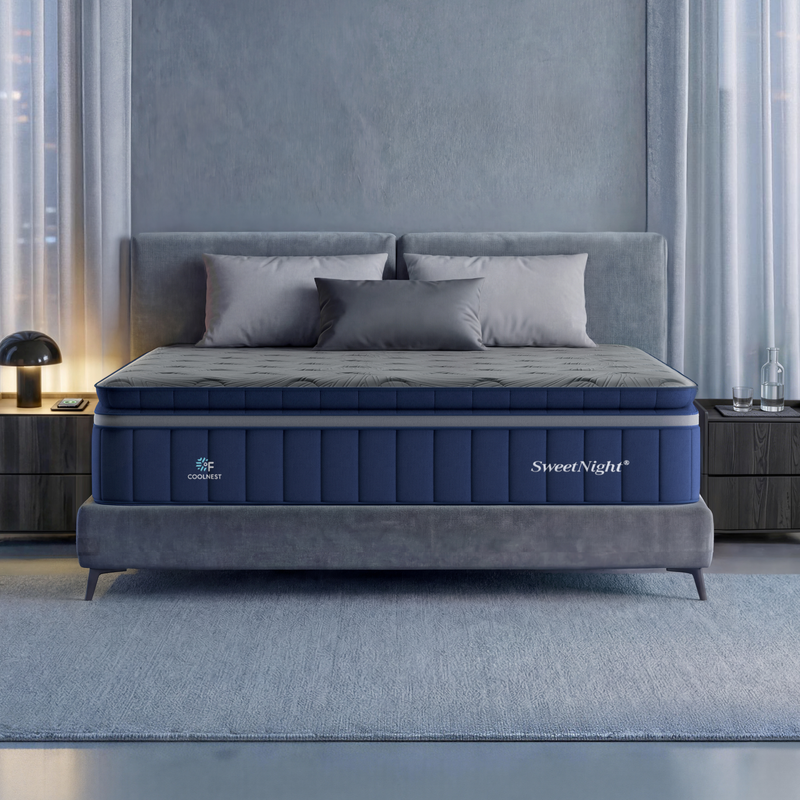
Best mattresses combine:
✓ Breathable open-cell foam
✓ Gel infusion (cooling)
✓ Phase-change materials (cooling)
✓ Coil ventilation (breathability)
✓ Perimeter vents (breathability)
This integrated approach handles heat-trapping room challenges.