



















Updated: August 11, 2026 · Reviewed by the SweetNight Sleep Comfort Team · 10 min read
Ask the internet how often to replace a mattress and you get "every 8 years," repeated with a confidence the number does not deserve. It is an average across wildly different products, and it tells you nothing about the specific mattress you are lying on tonight.
Some mattresses are finished at five years. Some are genuinely fine at twelve. Age is a weak predictor because what actually fails — foam losing its rebound, springs losing tension, a support core softening under the heaviest part of you — happens at a rate set by construction quality, your body weight, and whether you have been sleeping in the same 3-square-foot patch for a decade.
So replace it on evidence. You can measure the main failure mode with a piece of string, and diagnose the rest with a weekend away.
When to Replace a Mattress: Why the 8-Year Rule Is Useless
The 8-year figure comes from industry averages that blend a $300 innerspring with a $2,000 latex bed. Averaging those two tells you as much as averaging the lifespan of a bicycle and a truck.
Worse, it points people in both wrong directions at once. Someone with a cheap foam bed that collapsed at year four keeps it for another four because "it isn't time yet." Someone with a well-built latex mattress in perfect condition replaces it at year eight for no reason at all.
Two things actually determine when a mattress is done:
- Has the support core lost its structure? This is the failure that matters, because it is the one that changes your spinal alignment. It is measurable.
- Is it still doing its job for you specifically? Your weight, your position, and your body change over the ten years you own a bed. A mattress that suited you at 25 may be wrong at 40 without having degraded at all.
Everything below is a way of answering those two questions.
The Ruler Test: How to Measure Mattress Sag
This is the most objective check available to you, it costs nothing, and almost nobody does it.
- Strip the bed completely. Sheets, protector, topper — all off. A topper hides exactly what you are trying to see.
- Stretch a string taut across the mattress, from one side edge to the other, straight across the middle where you sleep. A long spirit level or a straight board works too.
- Measure the largest gap between the string and the mattress surface with a ruler.
- Repeat lengthwise, and repeat on both sides of the bed if two people sleep in it. The two sides often differ substantially, which is itself informative.
Read the result:
| Measured sag | What it means | Action |
|---|---|---|
| Under 0.75 in | Normal settling | Nothing. Rotate it and move on. |
| 0.75–1.5 in | Meaningful wear beginning | Check your warranty — many claims start valid in this band. Rotate monthly. |
| Over 1.5 in | Structural failure | Replace. A topper will follow the dip, not fill it. |
Why 1.5 inches matters: that is roughly the point at which your hips sit low enough relative to your shoulders and knees to put a lateral bend in your lumbar spine for the whole night. That is the mechanism behind the morning back pain, and it is why the measurement predicts symptoms better than the calendar does. The positional side of this is covered in why sleep position causes lower back pain.
Do this measurement with the bed empty. Sag under load is a different (and larger) number, and it is not what warranties measure.
7 Signs You Need a New Mattress
Ranked by how strongly each one actually predicts that replacement will help.
1. You wake with pain that fades within an hour
The strongest single indicator. Pain caused by a sleep surface is at its worst on waking and eases as you move, typically clearing within 30–60 minutes. Pain that builds through the day or peaks in the evening is coming from something else — posture, activity, or a condition worth investigating — and a new mattress will not touch it.
2. You sleep better in hotels or at other people's houses
Hard to argue with. If two nights in a mediocre hotel bed leave you feeling better than your own, the problem is your bed. See the hotel test below for how to run this deliberately.
3. Measurable sag over 1.5 inches
Covered above. Objective, and it correlates with symptoms better than anything else on this list.
4. You can feel the springs, or hear them
Feeling individual coils means the comfort layer above them has compressed to nothing. New noise from an innerspring means the coils are losing tension. Neither is repairable.
5. You roll toward the middle, or toward a dip
If you and a partner drift together overnight without meaning to, the support core has softened along the centre or under each of you. This also causes the disturbance of feeling every movement the other person makes.
6. Your allergies or asthma are worse in bed
Mattresses accumulate dust mite allergens over years. If you wake congested, sneezing, or wheezing and it improves during the day, an ageing mattress is a plausible contributor — particularly one that has never had a protector. How mattress construction affects dust mites covers which materials resist them.
7. You sleep hot in a room that is not hot
Often misread as a temperature problem. Older memory foam softens more as it ages and lets you sink deeper, which increases the contact area sealing heat against your body. If the room is 66°F and you still wake damp where you press into the bed, the surface is the cause; the mechanism is in why memory foam feels hot during sleep.
The Hotel Test: Is It the Mattress or Is It You?
Before spending money, rule out the alternative explanation — that your back hurts for reasons that will follow you to a new bed.
Run it deliberately: spend three or more consecutive nights on a different mattress — a hotel, a relative's spare room, a rental — and pay attention specifically to how you feel in the first hour after waking, not to how the bed felt when you got in.
- Pain gone or clearly reduced by night three → it is your mattress. Replacement is very likely to help.
- No difference → it is not primarily your mattress. Look at daytime posture, activity, stress, or a medical cause. A new bed will disappoint you.
- Worse away from home → your current mattress is doing something right. Note its firmness and construction before you replace it with something different.
Three nights matters. One night in an unfamiliar room tells you about the unfamiliar room, not about the mattress.
How Long Mattresses Actually Last, by Type
Realistic ranges, assuming average use and a proper supportive base:
| Construction | Typical lifespan | How it usually fails |
|---|---|---|
| Latex | 10–15 years | Slow surface softening; the core outlasts everything else |
| High-density memory foam | 8–10 years | Body impressions form where you sleep; loses rebound |
| Low-density memory foam | 4–6 years | Rapid permanent compression — the density spec matters more than the brand |
| Pocketed-coil hybrid | 7–10 years | Comfort layer wears out before the coils do |
| Traditional innerspring | 5–7 years | Coil tension loss, sagging, noise |
| Pillow-top | 5–7 years | The pillow-top flattens permanently while the core is still fine |
Foam density is the specification that predicts longevity, and it is the one most often missing from a product page. If a memory foam mattress does not publish its density, assume it is low. That is also why two mattresses that feel identical in a showroom can be four years apart in useful life — the comparison across our own range is in CoolNest vs Pro vs Ultra vs Hybrid.
What Shortens a Mattress's Life
Most premature failures are caused by four avoidable things.
- An inadequate base. The most common and most expensive mistake. Slats more than about 3 inches apart let foam sag between them, and the mattress fails from underneath in a year or two. Most warranties are void without adequate support, so this also costs you the claim.
- Never rotating it. Sleeping in the same spot concentrates every night's load onto the same small area. Rotating head-to-foot every three months spreads it. Do not flip a one-sided mattress — it is built with the support core at the bottom.
- No protector. Moisture is genuinely damaging to foam over time, and body moisture is unavoidable. A breathable protector adds years; a sealed vinyl one adds years but makes the bed sleep hotter, so choose a membrane type.
- Sitting on the edge daily. The perimeter takes concentrated load in a small area. If you always sit in the same spot to put your shoes on, that edge will collapse first.
Can You Fix It Instead of Replacing It?
Sometimes, and it is worth checking before spending several hundred dollars.
| Problem | Fixable? | How |
|---|---|---|
| Too firm | Yes | A soft topper genuinely solves this — see why a mattress topper can be a game changer |
| Too soft, core intact | Partly | A firm latex topper helps; plywood under the mattress is a short-term bodge that hurts airflow |
| Sleeps hot | Yes | Cooling topper, breathable protector, better sheets |
| Sagging over 1.5 in | No | Nothing added on top fixes a structural dip — it conforms to it |
| Broken or noisy springs | No | Replace |
| Sagging only in the middle of a shared bed | No | Core failure; also check the base for a missing centre support leg |
The rule that covers all of it: a topper changes the feel of the surface; it cannot restore the structure underneath. If the string test showed a real dip, adding foam on top just puts a new soft layer into the same hole.
What to Buy Next
If you have concluded it is time, buy against what failed rather than against a brand.
- It sagged early → prioritise support-core density and check the warranty's sag threshold. A pocketed-coil hybrid resists impressions better than an all-foam bed for heavier sleepers.
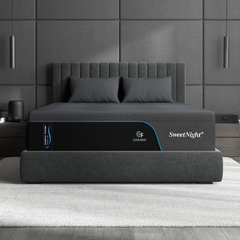
- It slept hot → look for open-cell or gel-infused foam, or a hybrid whose coil layer lets air move. Our CoolNest® Ultra cooling memory foam mattress targets this directly, and the best cooling mattress for hot sleepers compares the options.
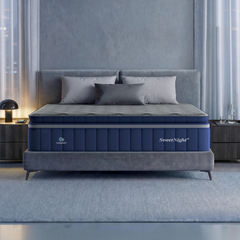
- It hurt your hips or shoulders → you need more contouring at the pressure points, not more firmness. The CoolNest® Hybrid Mattress pairs pressure relief with coil support.
- You and your partner disagree → look at motion isolation and consider firmness on each side; the trade-offs are in mattress thickness, body type and sleep position.
Current offers across the range are on the SweetNight deals page, and the full lineup is in the cooling mattress collection. Whatever you buy, check your bed base at the same time — replacing a mattress onto the base that killed the last one is how people end up doing this twice.
Frequently Asked Questions
Does a mattress really double in weight from dust mites?
No. This is a widely repeated claim with no basis. Mattresses do accumulate dust, skin cells and moisture over years, and that is a legitimate hygiene reason to use a protector and replace eventually — but the weight figure is a myth.
Should I replace my mattress if only my partner's side has sagged?
Usually yes, because you cannot replace half a mattress and the sagged side will keep pulling both of you toward it. Before buying, check that the base has a centre support and rotate the mattress — if the dip is recent and shallow, rotating can even out the load.
How long does a new mattress take to break in?
Two to four weeks for foam, and your body needs a similar period to adapt. Judge a new mattress at week four, not week one. If it is clearly wrong after 30 nights, that is what the sleep trial exists for.
Is it worth claiming on the warranty?
Worth checking. Most warranties cover sag beyond a stated depth, commonly 0.75–1.5 inches, measured with the bed unloaded — which is exactly the string test. The two things that void claims most often are an inadequate base and stains, so photograph your measurement and your slat spacing before you contact anyone.
Can an old mattress cause bad sleep even without pain?
Yes. Pressure builds where a worn surface no longer contours, and your body responds by shifting position more often. Those movements are brief arousals you will not remember, and they show up as feeling unrested despite a full night in bed.
What do I do with the old one?
Many municipalities run bulky-waste collection, and mattress recycling schemes exist in a growing number of areas — the steel, foam and fibre are all recoverable. Some retailers remove the old mattress on delivery, which is worth asking about before you order.
The Bottom Line
Stop counting years. Strip the bed, stretch a string across it, and measure. More than 1.5 inches of sag means the structure has failed and nothing you put on top will fix it.
If the measurement is fine but you still wake sore, run the hotel test for three nights before spending anything — it separates a bad mattress from a problem that will follow you to a new one. And when you do replace, buy against the specific way the old one failed. That is the difference between solving the problem and repeating it in seven years.